Why We Recommend Replacing Bishop Swamp Coolers With Ductless Mini-Splits
Why We Recommend Replacing Bishop Swamp Coolers With Ductless Mini-Splits
Myth: Traditional Swamp Coolers Are Always Enough for the Eastern Sierra
There is a long-standing belief that evaporative cooling is all you will ever need to stay comfortable in a high-desert climate. Why we recommend replacing Bishop swamp coolers with ductless mini-splits comes down to a harsh reality: when those brutal August late-summer heatwaves hit, traditional coolers simply cannot keep up with the demand. You might notice the air blowing from your vents feels damp and lukewarm, leaving your living space sticky and uncomfortable just when you need relief the most.
For decades, homeowners have accepted this late-summer slump as just a normal part of living in the region. But you no longer have to sweat through the end of the season with an underperforming system. Modern HVAC technology has evolved, positioning ductless mini-split systems as the definitive, load-bearing solution for consistent indoor comfort. If you are tired of crossing your fingers and hoping your evaporative cooler survives the next temperature spike, exploring an AC replacement in Bishop is the most effective way to take back control of your home's climate.
The Climate Physics: Why Evaporative Cooling Fails in Late Summer
To understand why a swamp cooler struggles when you need it most, you have to look at the basic science of how it operates. Evaporative coolers rely entirely on adding moisture to dry air. A water pump saturates fibrous pads, and a large blower fan pulls hot outside air through those wet pads, lowering the air temperature through evaporation. It is a simple process, but it has a hard physical limit based on ambient temperature and outdoor humidity.
When Bishop's specific late-summer temperature spikes push into the upper 90s and low 100s, this mechanical process breaks down. The cooling capacity of an evaporative system drops drastically because the air can only absorb so much moisture before the evaporation process stalls. By contrast, refrigerated air systems do not rely on evaporation at all. They use chemical refrigerants to actively absorb and remove heat from your home, pumping it outside regardless of how hot the outdoor air gets.
The Temperature Threshold of Swamp Coolers
When outdoor temperatures exceed 95 degrees, the water evaporation mechanics inside a swamp cooler begin to fail at their primary job. While the blower motor might still be pushing a high volume of air into your home, that air is no longer being significantly cooled.
• The difference between a breeze and actual cooling: A swamp cooler in extreme heat might create a breeze that feels slightly cooler on your skin due to sweat evaporation, but it is not actually lowering the ambient temperature of the room.
• The wet-bulb limit: Evaporative cooling is limited by the "wet-bulb" temperature. If the outside air is extremely hot, the physical temperature drop achievable through evaporation shrinks to a few mere degrees.
• Heat gain outpaces cooling: During August late-summer heatwaves, the radiant heat entering your home through the roof and windows quickly outpaces the weak cooling output of a struggling swamp cooler.
Monsoon Moisture and Humidity Spikes
The second major physical limitation of swamp coolers is their extreme vulnerability to humidity. Late summer in the Eastern Sierra often brings monsoon moisture, which suddenly increases local humidity levels.
When the outside air is already holding a significant amount of moisture, the water on your evaporative pads cannot evaporate. Instead of blowing cool, refreshing air, your system begins blowing warm, sticky, humid air directly into your living space. Adding moisture to an already hot and humid environment creates a miserable, muggy indoor climate that encourages mold growth and makes it incredibly difficult for your body to cool itself naturally.
The Wildfire Smoke Threat: Protecting Your Indoor Air Quality
Beyond basic temperature control, there is a critical, often-overlooked vulnerability of swamp coolers that directly impacts your family's health. Swamp coolers function by constantly pulling massive amounts of outside air into the home. They operate on a principle of positive pressure, requiring you to crack windows or doors so the incoming air has somewhere to escape.
During August late-summer heatwaves, the Eastern Sierra is frequently blanketed by wildfire smoke. When a swamp cooler is running during a smoke event, it acts as a giant vacuum, actively drawing hazardous wildfire smoke, ash, and microscopic particulate matter directly into your living room. The standard fibrous pads inside a swamp cooler are designed to hold water, not to filter out dangerous PM2.5 smoke particles. The resulting indoor air quality risks are severe, leaving homeowners to choose between sweltering in the heat or breathing in toxic air.
How Swamp Coolers Compromise Air Quality
The mechanics of drawing outside air over wet pads create a direct pathway for outdoor pollutants to enter your home. Because swamp coolers require an open-air circuit to function, your home is never truly sealed from the outside environment.
• Zero particulate filtration: Standard evaporative cooler pads cannot filter out microscopic smoke particulates, vehicle exhaust, or fine dust.
• Forced air intake: By forcing outside air inside, a swamp cooler guarantees that whatever is in the outdoor air—pollen, ash, or smoke—will end up in your lungs.
• Moisture and mold risks: When combined with poor ventilation, the constant influx of moisture can lead to hidden mold growth inside wall cavities, further degrading indoor air quality.
The Filtration Advantage of Refrigerated Air
Ductless mini-splits solve this dangerous air quality dilemma entirely. Instead of pulling outside air into the house, modern ductless systems recirculate and filter the indoor air you already have. The outdoor compressor simply moves heat, not air.
This means you can completely seal your home's windows and doors during a wildfire smoke event. The advanced, multi-stage filtration systems built into ductless air handlers actively scrub your indoor air, removing dust, allergens, and smoke particulates. This crucial filtration advantage ensures that your home remains a clean, breathable sanctuary during the worst of fire season.
The Manufactured Home Challenge: Overcoming Heat Retention
Architectural design plays a massive role in how a home handles heat, and mobile and manufactured homes face unique structural challenges. These structures often feature less insulation, thinner walls, and metal roofing components that transfer heat much faster than traditional stick-built houses. Because they lack the deep thermal mass of a standard home, manufactured homes heat up incredibly quickly once the sun hits them.
This rapid heat retention requires robust, load-bearing cooling to maintain comfort. When a swamp cooler fails to deliver cold air, a manufactured home can reach dangerous temperatures in a matter of hours. During a particularly hot and humid Bishop summer, one local homeowner found their old swamp cooler completely ineffective against the rising temperatures. After reaching out for a solution, technicians installed two strategic mini-split units, instantly transforming the property and ensuring the home remained comfortable regardless of the outside humidity. For Bishop and Eastern Sierra mobile home communities, getting a new AC installation that uses ductless technology provides powerful, targeted cooling exactly where it is needed most.
Why Mobile Homes Heat Up Faster
The physics of heat transfer through manufactured home walls and roofs demand a cooling system that can fight back aggressively. The thin exterior envelope of a mobile home offers very little resistance to radiant heat gain.
• Rapid thermal bridging: The metal frames and thinner wall studs in manufactured homes transfer outside heat directly to the interior walls.
• Low insulation values: Older mobile homes often have minimal roof and wall insulation, allowing the midday sun to bake the interior space.
• The need for steady capacity: Because the home cannot naturally hold onto cool air for long, a steady, powerful stream of actively refrigerated air is required to counteract the rapid heat gain.
Bypassing the Ductwork Dilemma
Retrofitting traditional ducted central air into a mobile home is often a structural nightmare. The existing ductwork in older manufactured homes is typically too small, poorly insulated, or entirely degraded, making it impossible to handle the airflow required for a modern central AC system.
Ductless technology is the ideal architectural fit because it bypasses the ductwork dilemma completely. By mounting sleek indoor air handlers directly on the walls of your primary living spaces, you deliver cold air straight to the room without losing efficiency to leaky, under-floor ducts.
Side-by-Side Comparison: Swamp Coolers vs. Ductless Systems
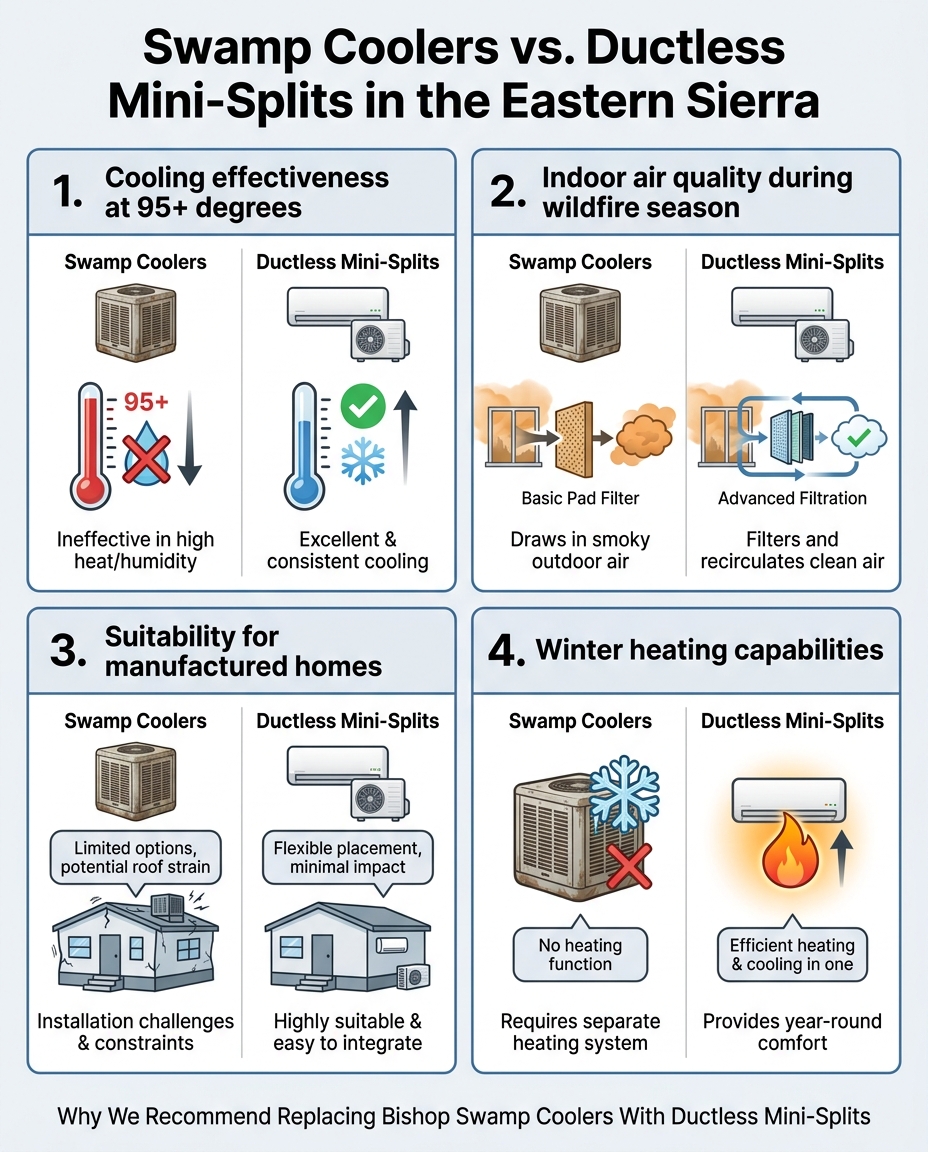
When evaluating evaporative swamp coolers vs. ductless mini-splits, a direct comparison reveals exactly why ductless technology is rapidly becoming the standard for modern comfort. The differences in performance, air quality, and year-round utility are stark, especially when dealing with the extreme weather patterns of the high desert.
• Cooling at 95°F+ — Traditional Swamp Cooler: Efficiency drops dramatically; often blows warm air. — Ductless Mini-Split System: Maintains exact thermostat temperature easily.
• High Humidity Performance — Traditional Swamp Cooler: Fails completely; makes the home muggy and damp. — Ductless Mini-Split System: Actively dehumidifies the air while cooling.
• Wildfire Smoke Response — Traditional Swamp Cooler: Pulls toxic smoke and ash directly into the home. — Ductless Mini-Split System: Seals the home and filters recirculated indoor air.
• Water Usage — Traditional Swamp Cooler: Consumes dozens of gallons of water per day. — Ductless Mini-Split System: Uses zero water; entirely refrigerant-based.
• Winter Utility — Traditional Swamp Cooler: Useless; requires draining and winterizing. — Ductless Mini-Split System: Provides highly efficient electric heating all winter.
Cooling Performance in Extreme Heat
The most immediate difference homeowners notice after an upgrade is the sheer reliability of the cooling performance. Swamp coolers drop efficiency dramatically as heat rises, making them weakest when you need them most. Ductless systems, driven by advanced compressors, maintain consistent, thermostat-driven temperatures no matter what the thermometer outside reads.
Year-Round Versatility
The hassle of draining water lines, removing pads, and covering swamp coolers before the first winter freeze is a tedious annual chore. Ductless mini-splits eliminate this seasonal maintenance. Because they are heat pumps, they provide a unified heating and cooling system in one unit. With the press of a button on a remote control, your summer air conditioner becomes a powerful, efficient winter heater.
Swamp Coolers vs. Ductless Mini-Splits in the Eastern Sierra
Seamless Upgrades: Local Expertise for Your Retrofit
Transitioning away from an evaporative cooler is a straightforward process when handled by professionals who understand the specific architectural quirks of Bishop and Eastern Sierra mobile home communities. MCR Services Inc. brings specific expertise in retrofitting HVAC systems for mobile and manufactured homes, ensuring the unique structural requirements, weight limits, and electrical loads are handled correctly from day one. Upgrading your system is minimally invasive and yields immediate comfort.
1. Professional Load Calculation: The process begins with a precise measurement of your home's square footage, insulation levels, and window placements to ensure the new system is sized perfectly for the high-desert climate.
2. Strategic Equipment Placement: The slim outdoor compressor is positioned in a discreet location outside, while the indoor air handlers are mounted high on the walls of your most-used rooms to maximize airflow and efficiency.
3. Electrical Assessment: Technicians evaluate your electrical panel to ensure it can safely support the dedicated circuits required for the new heat pump technology.
4. Refrigerant Line Routing: Small, unobtrusive conduits are run through the exterior walls to connect the indoor and outdoor units, completely bypassing the need for bulky ductwork.
5. System Commissioning: The new system is powered on, calibrated, and tested to ensure it delivers immediate, icy-cold air, finalizing your upgrade to premium Bishop HVAC services.
Long-Term Efficiency and Protecting Your Investment
Making the leap from evaporative swamp coolers vs. ductless mini-splits is an investment in the long-term value and livability of your home. Modern ductless systems utilize advanced inverter technology, which allows the compressor to variable adjust its speed based on real-time cooling demands. Instead of turning on and off in loud, energy-wasting cycles like a traditional AC, an inverter system quietly ramps up and down, sipping electricity while maintaining a perfectly even temperature.
Furthermore, ductless setups offer built-in zoning capabilities. Because each indoor air handler operates independently, you can cool only the rooms you are actively using. You can keep the living room freezing cold during the day while setting the unoccupied bedroom to a more energy-saving temperature, drastically reducing your overall utility footprint.
While generic energy rebates and federal tax credits often apply to high-efficiency heat pump upgrades, the most immediate payoff is in your daily comfort and air quality. Protecting this investment requires very simple upkeep compared to the constant scaling, rusting, and pad replacement associated with swamp coolers. By keeping up with basic filter cleanings and maintaining your mini-split through annual professional tune-ups, your system will deliver reliable performance for years to come.
Secure Your Comfort Before the Next Heatwave
You do not need to tolerate failing cooling, muggy indoor humidity, and poor air quality every time August late-summer heatwaves roll through the valley. The physical limitations of evaporative cooling are clear, and ductless technology stands as the definitive solution for reliable, load-bearing comfort in high-desert manufactured homes. Take action today to schedule a professional assessment, secure your upgrade, and ensure your home remains a cool, smoke-free sanctuary no matter what the late-summer weather brings.
Frequently Asked Questions
Why is my swamp cooler not cooling in late summer?
Your swamp cooler loses effectiveness in late summer because evaporative cooling relies on dry heat to function. When temperatures climb above 95 degrees, or when late-summer monsoon moisture spikes the outdoor humidity, the water on the cooler pads cannot evaporate efficiently. Without evaporation, the system simply blows warm, damp air into your home instead of actually lowering the ambient temperature.
Can a mini split replace a swamp cooler in a mobile home?
Yes, a ductless mini-split is the ideal replacement for a swamp cooler in a mobile or manufactured home. Because mini-splits do not require extensive ductwork, they bypass the structural limitations of thin walls and shallow floor cavities found in mobile homes. The indoor air handlers mount directly to the wall, delivering powerful, refrigerated air exactly where you need it to combat rapid heat gain.
How do mini splits handle wildfire smoke compared to evaporative coolers?
Mini-splits actively protect your indoor air quality during wildfire season by recirculating and filtering the air already inside your home. Evaporative coolers, on the other hand, pull 100% of their air from the outside, drawing toxic smoke and ash directly into your living space. With a mini-split, you can safely close all your windows and rely on the unit's built-in filtration to keep your indoor air clean and breathable.
Are mini splits better than evaporative coolers in California?
Mini-splits are significantly better than evaporative coolers for modern California climates due to their ability to handle extreme heat and protect against wildfire smoke. While swamp coolers use dozens of gallons of water a day and fail during heatwaves, mini-splits use zero water, operate efficiently in triple-digit heat, and provide the added benefit of high-efficiency electric heating during the winter months.
Can you put a mini split in a manufactured home without ductwork?
Absolutely. The primary advantage of a ductless mini-split is that it requires no ductwork whatsoever. The system connects an outdoor compressor to indoor wall-mounted air handlers using a small bundle of refrigerant lines and electrical cables that only require a three-inch hole in the wall. This makes installation in manufactured homes fast, minimally invasive, and highly effective.
Do I need to remove my old swamp cooler to install a ductless system?
While you do not technically have to remove the old swamp cooler immediately to install a mini-split, it is highly recommended to seal off the old unit. Leaving an unused swamp cooler on your roof or in your window creates a massive draft point where conditioned air can escape and hot outdoor air can enter. Properly removing and sealing the old unit ensures your new ductless system operates at peak efficiency.
How does the energy consumption of a mini-split compare to a swamp cooler?
While a swamp cooler generally uses less electricity because it only runs a fan and a water pump, a mini-split offers vastly superior energy efficiency when compared to traditional central air conditioning. Mini-splits use advanced inverter technology to modulate their power usage, and their ability to create cooling zones means you only pay to cool the rooms you are actively using. Furthermore, mini-splits completely eliminate the heavy daily water consumption required by swamp coolers.
Sed iaculis aenean sit sed risus arcu vitae integer elit.
5 min read
Why We Recommend Replacing Bishop Swamp Coolers With Ductless Mini-Splits
When August heatwaves hit the Eastern Sierra, traditional evaporative cooling often struggles to keep up. Upgrading to a ductless mini-split ensures reliable, load-bearing comfort.
Learn the key differences between air purifiers and humidifiers. MCR Services Inc. helps you choose the right solution for your indoor air quality needs.