How Often Should I Change My Furnace Filter During a Dusty High-Desert Fall?
How Often Should I Change My Furnace Filter During a Dusty High-Desert Fall?
Why High-Desert Autumns Demand a Different Approach to Furnace Maintenance
If you find yourself asking, "How Often Should I Change My Furnace Filter During a Dusty High-Desert Fall?" as the winds start rattling your windows, you are certainly not alone. If you live in the Mammoth Lakes region, you already know that the transition into colder weather brings a massive uptick in airborne dust. You dust your coffee table in the morning, and by the afternoon, a fine layer of grit has already returned. This same heavy particulate load is being pulled directly into your home's heating system the moment your thermostat calls for heat.
Many homeowners find themselves confused by the generic guidelines printed on the side of standard air filter packaging. Most manufacturers confidently state that their filters will last up to 90 days. However, those timelines are based on baseline testing in average, mild climates with standard indoor dust levels consisting mostly of pet dander, skin cells, and clothing lint. They do not account for the intense environmental realities of the Autumn wind season (October), which stirs up heavy, fine soil from the desert floor and forces it into your home's envelope. Relying on a 90-day schedule in these conditions is a guaranteed way to suffocate your heating equipment.
The 90-Day Myth vs. Regional Reality
When you rely on a three-month replacement cycle in an arid environment, you are essentially asking a thin piece of pleated paper to hold back a relentless tide of fine soil. As the filter media loads up with this dense particulate matter, the microscopic holes that allow air to pass through become completely blocked. This creates severe airflow restriction long before the 90-day mark is reached. Understanding the specific demands of your local climate is the first step in protecting your heating system from premature wear and tear.
How Often Should You Replace Your Filter in a Dusty Environment?
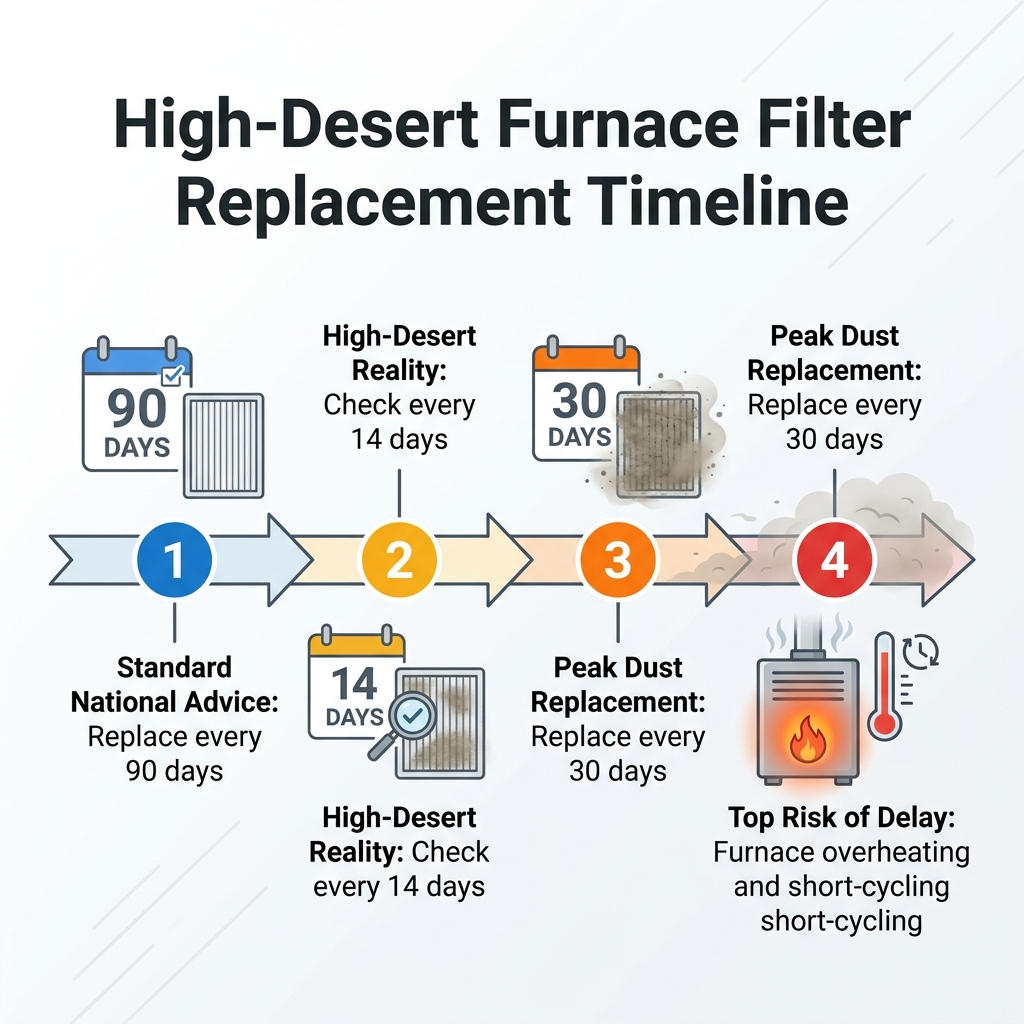
The quick answer: During peak dusty conditions in the fall, you should check your furnace filter every two weeks and replace it every 20 to 30 days. Waiting any longer than a month during periods of high wind and heavy airborne dust significantly increases the risk of airflow restriction, which can severely damage your heating equipment.
Standard 1-inch to 2-inch pleated filters simply do not have the surface area required to survive a 90-day cycle when subjected to heavy, continuous particulate matter. Here is why the timeline compresses so dramatically in our region:
• Accelerated loading: Fine desert soil packs tightly into the filter fibers, blocking airflow much faster than fluffy household lint or pet hair.
• Continuous operation: As temperatures drop, your furnace blower runs more frequently, pulling a higher volume of dirty air across the filter media every single day.
• Baseline testing discrepancies: Filter manufacturers test their products in controlled, average environments, not in the middle of a high-desert wind event.
At MCR Services, our deep local expertise in maintaining HVAC systems against these unique high-desert dust challenges has shown us exactly what happens when standard advice is applied to extreme environments. In our years of providing heating services across Mammoth Lakes, Bishop, and the Eastern Sierra, our team routinely pulls 30-day-old filters from local homes that look worse than 6-month-old filters from coastal or humid climates. The sheer volume of particulate matter in the air requires a highly proactive approach to system maintenance.
High-Desert Furnace Filter Replacement Timeline
How Eastern Sierra Autumn Winds Accelerate Filter Clogging
To truly understand why your filter lifespan is cut by two-thirds during the fall, you have to look at the environmental science of the region. The dust we experience here is fundamentally different from the standard indoor pollutants found in most American homes. Standard household dust is relatively light and fluffy. The fine alkaline dust blown off the desert floor, however, is dense, heavy, and microscopic.
During the Autumn wind season (October), arid, high-wind events sweep across the valley before the winter snows arrive. These sustained winds create immense positive pressure against the exterior of your home. This pressure forces micro-particles of fine desert soil through tiny gaps in your home's envelope—around window frames, under door sweeps, and through microscopic cracks in the siding. Once this dust enters your living space, it remains suspended in the air until your heating system turns on.
The Mechanics of Dust Infiltration and Filtration
When your thermostat signals the furnace to start, the powerful blower motor activates. This motor pulls air from every room in your house through the return ducts, dragging all that suspended alkaline dust along with it. All of this air must pass through your furnace filter before it reaches the heat exchanger. Because fine desert dust is so dense, it coats the filter media in a solid, restrictive layer much faster than typical household debris.
This rapid accumulation is why proactive heating and cooling in Bishop requires constant vigilance. As the heavy dust load builds up, the filter stops acting as a protective screen and starts acting like a solid wall. The blower motor continues to try and pull air through this wall, creating an intense vacuum effect that stresses every mechanical component in the system.
The Danger of Entering Mountain Winter with a Partially Clogged Filter
The Problem: Many homeowners assume that a dirty filter just means slightly dustier air inside the house. In reality, a clogged filter is a severe mechanical hazard. It is the single leading cause of furnace overheating and catastrophic breakdowns during the early heating season.
The Cause: Your furnace relies on a precise volume of air flowing over the heat exchanger to keep the metal from getting too hot. When a filter becomes caked with dirt from the Bishop and Eastern Sierra high-desert, that airflow is choked off. The heat exchanger continues to generate intense heat, but there is no air moving across it to carry that heat into your home. The internal temperature of the furnace rapidly spikes to dangerous levels. To prevent a fire or a cracked heat exchanger, a built-in safety device called a high-limit switch forces the burner to shut off prematurely. This rapid on-and-off sequence is known as "short-cycling."
The Solution: Maintaining a strict 30-day replacement schedule during the dusty season prevents this dangerous chain reaction. When you ensure proper airflow, you protect the blower motor, which otherwise has to work twice as hard to push air through a wall of dirt. This reduces electrical consumption and prevents the motor from burning out entirely.
Equipment Impact: Clean vs. Clogged Filters
• Blower Motor — With a Clean Filter: Operates at normal amperage, spinning freely. — With a Clogged Filter: Strains against high static pressure, risking burnout.
• Heat Exchanger — With a Clean Filter: Transfers heat efficiently to the passing air. — With a Clogged Filter: Overheats rapidly, risking metal fatigue and cracking.
• Limit Switch — With a Clean Filter: Remains inactive during normal heating cycles. — With a Clogged Filter: Trips frequently, causing the system to short-cycle.
Prioritizing filter changes is the easiest and most effective way to ensure reliable HVAC system performance as temperatures drop toward freezing.
Choosing the Right Filter Thickness and MERV Rating for Fall Air
Not all filters are created equal, and selecting the right one for a dusty environment involves balancing filtration capability against airflow restriction. The two most important factors to consider are the thickness of the filter and its MERV (Minimum Efficiency Reporting Value) rating.
Standard 1-inch filters are the most common, but they have a very limited surface area. Because they are so thin, they clog extremely fast during the Autumn wind season (October). If your system accommodates it, upgrading to a 4-inch media cabinet provides drastically more surface area. The deep pleats in a 4-inch filter allow it to capture significantly more dust before airflow is compromised, often extending the replacement timeline even in harsh environments.
Understanding MERV Ratings
The MERV rating dictates how small of a particle the filter can capture. While it might seem logical to buy the highest rating possible to combat fine desert dust, this is a dangerous misconception.
• MERV 1 to 4: Basic fiberglass filters. They stop large debris like lint and bugs but allow fine desert dust to pass right through into your equipment.
• MERV 5 to 8: Good standard filtration. Captures mold spores, dust mites, and most household dust without severely restricting airflow.
• MERV 9 to 12: The sweet spot for high-dust regions. Captures fine alkaline dust and pet dander effectively while still allowing modern blower motors to breathe.
• MERV 13 to 16: Hospital-grade filtration. Excellent for air quality, but often too restrictive for standard residential blowers. Using these without professional verification can choke your system just like a clogged filter.
For most homeowners dealing with blowing dust, a pleated filter rated between MERV 8 and MERV 11 offers the best balance of system protection and indoor air quality. If you are also dealing with seasonal fires, understanding MERV ratings for filtering fall air becomes even more critical to ensure your system can handle the added strain of smoke particulates.
Visual and Operational Signs Your Furnace Filter is Full
You do not need special tools or technical training to know when your filter has reached its capacity. The environment in the Bishop and Eastern Sierra high-desert will provide clear, actionable signs that it is time for a replacement. By performing a few simple DIY checks, you can stay ahead of severe airflow restriction.
Here are the clearest indicators that your filter is fully loaded and needs immediate replacement:
• The light test: Pull the filter out and hold it up to a bright overhead light or the sun. If you cannot see light shining through the pleated media, the microscopic holes are completely blocked. It is fully clogged and must be thrown away.
• Dust accumulation on grilles: Check your return grilles (where air is pulled in) and supply registers (where warm air blows out). If you see heavy dust clinging to the metal louvers, it means the filter is no longer trapping airborne particles effectively, allowing them to circulate through the ductwork.
• Extended heating cycles: If your furnace seems to be running for much longer periods than normal just to reach the temperature set on the thermostat, airflow is likely restricted. The system is struggling to transfer heat into the home.
• Unusual whistling noises: A highly restrictive, dirty filter increases the static pressure inside the return duct. This intense vacuum effect can cause air to squeeze through tiny gaps around the filter housing, creating a noticeable whistling or howling sound when the blower is running.
Frequently Asked Questions About Desert HVAC Maintenance
Does a dusty house mean I need to change my furnace filter?
Yes, excessive dust settling on furniture shortly after cleaning is a primary indicator that the filter is no longer trapping airborne particles effectively. When a filter is full, the air simply bypasses the media or forces fine particulate matter back into the airstream. Changing the filter will immediately improve the system's ability to clean the air circulating through your home.
What happens if I don't change my furnace filter before winter?
Leaving a dirty filter in place can lead to system overheating, frequent shut-offs (short-cycling), and potentially a complete breakdown during the coldest months. The restriction of airflow causes the internal heat exchanger to reach dangerous temperatures, forcing the safety limit switch to shut the furnace down. Entering winter with a clean filter is the most important step in preventing emergency no-heat situations.
How often should I change my HVAC filter in the desert?
In arid, dusty climates, checking every 14 days and replacing every 30 days is the recommended baseline, overriding standard 90-day manufacturer suggestions. The intense Autumn wind season (October) blows fine alkaline dust into the home, which packs tightly into filter pleats and restricts airflow far faster than normal household lint.
Can a dirty filter cause my furnace to shut off?
Yes, modern furnaces have built-in limit switches that will shut the system down if restricted airflow causes internal temperatures to rise to dangerous levels. This safety mechanism prevents fires and cracked heat exchangers, but it results in a furnace that turns on and off repeatedly without actually warming the house. A fresh filter restores the necessary airflow to keep the system running steadily.
Are washable filters better for high-dust areas?
While reusable, washable filters often have lower MERV ratings and may not capture the fine alkaline dust prevalent in high-desert regions as effectively as pleated disposable filters. Furthermore, cleaning a washable filter thoroughly enough to remove deeply embedded microscopic desert soil is incredibly difficult. For optimum equipment protection, high-quality disposable pleated filters are generally superior in this climate.
Prepare Your Heating System for the Winter Ahead
Staying ahead of the dust is the absolute best way to protect your heating system in the Bishop and Eastern Sierra high-desert. By ignoring the generic packaging advice and adopting a strict 30-day replacement schedule, you ensure that your furnace has the airflow it needs to operate safely and efficiently. A clear, climate-specific timeline for checking and changing filters during the windy fall season prevents unexpected breakdowns and explains exactly why generic advice doesn't work for high-desert homes.
Don't wait for the first deep mountain freeze to find out your system is struggling to breathe. Secure a routine HVAC maintenance plan today to ensure your equipment is fully optimized, inspected, and ready to keep you comfortable all winter long.
Sed iaculis aenean sit sed risus arcu vitae integer elit.
5 min read
Addressing Common Heating Failures in Round Valley Rural Properties
October cold snaps in the Eastern Sierra often expose hidden vulnerabilities in propane furnaces. See how local grid surges trigger unexpected lockouts and how to protect your rural heating system.
Standard Inverter vs. Cold-Climate Heat Pumps: A Mammoth Lakes Performance Review
Many homeowners believe any modern heat pump can handle a High Sierra winter. Discover why upgrading to a hyper-heat compressor is crucial before sub-zero temperatures hit.
Deciphering AFUE Ratings When Upgrading Your Furnace This Fall
Understanding how AFUE percentages translate to actual heating performance is critical before winter hits. See what an 80% versus a 90% rating really means for your fuel usage.