Standard Inverter vs. Cold-Climate Heat Pumps: A Mammoth Lakes Performance Review
Standard Inverter vs. Cold-Climate Heat Pumps: A Mammoth Lakes Performance Review
The Myth of the Universal Heat Pump in the High Sierra
A common misconception circulating in the HVAC industry is that any modern heat pump can easily handle winter weather. But when looking at a Standard Inverter vs. Cold-Climate Heat Pumps: A Mammoth Lakes Performance Review, the reality of high-altitude winters tells a completely different story. Many homeowners are led to believe that a standard variable-speed unit will keep them warm year-round, only to discover a harsh truth when temperatures plummet. The concrete problem is that standard inverter technology simply cannot extract enough heat from the air during extreme sub-zero temperature drops, leaving homes freezing just when reliable warmth is needed most.
This is why making the right choice during your mid-fall October pre-winter inspection is so critical. If you are preparing your home for the snowy months ahead, the decision point comes down to whether you specify a standard model or upgrade to a hyper-heat compressor designed for extreme climates. Making the wrong choice now means relying on incredibly inefficient backup heating methods by December. If you want to ensure your home stays comfortable, it is vital to evaluate your heating systems before the heavy snows arrive and the window for straightforward HVAC upgrades closes completely.
The Physics of Heating at 7,800 Feet: Why Elevation Matters
Heating a home in the Eastern Sierra is not like heating a home on the coast or even in the Northeast. The unique combination of extreme cold and the specific Mammoth Lakes / High Sierra altitude fundamentally changes how HVAC equipment performs. At elevations exceeding 7,800 feet, the air density is significantly lower than it is at sea level. Because heat pumps work by extracting ambient heat energy from the outside air and moving it indoors, they rely heavily on the mass of the air passing over their outdoor coils.
When the air is thin, there is simply less physical mass from which to extract that thermal energy. This means that generic cold-climate advice—often based on sea-level testing data from the Northeast United States—completely fails to account for the realities of our local microclimate. A standard heat pump that claims to work down to 15 degrees Fahrenheit in a coastal city will struggle to provide the same capacity here because the thin mountain air forces the compressor and fan to work much harder to capture the same amount of heat.
Furthermore, the combination of heavy snow loads and prolonged sub-zero drops demands a specialized approach to HVAC design. You cannot just place a standard unit outside and expect it to survive being buried in snow while trying to process freezing, thin air. Designing high-altitude, extreme-cold HVAC solutions requires deep local expertise. We understand exactly how elevation alters heat transfer calculations, which is why we approach every installation with the specific challenges of the high mountain climate in mind.
Standard Inverter Compressors: Where They Fall Short
To understand why standard units struggle in the mountains, you have to look at how they operate. Standard inverter compressors are a massive step up from older, single-stage heat pumps. They can ramp their speed up and down to match the heating demand of the home, which makes them incredibly efficient during mild weather. However, their mechanical limitations become glaringly obvious when they face extreme sub-freezing lows.
The problem: As the outdoor temperature drops, the amount of available heat energy in the air decreases. A standard inverter compressor tries to compensate by running faster, but it eventually hits a mechanical wall. It simply cannot compress the extremely cold, thin refrigerant vapor enough to generate the high temperatures needed to warm your home.
The cause: This limitation is reflected in the system's Coefficient of Performance (COP). The COP is a simple ratio: for every unit of electrical energy the system consumes, how many units of heat energy does it produce? In mild 50-degree weather, a standard inverter might have a COP of 3.0 or higher. But as the outdoor coil struggles to extract ambient heat from sub-zero air, that COP drops sharply, often approaching 1.0. At that point, the system is no more efficient than a basic electric space heater.
The solution: Overcoming this mechanical limitation requires a completely different approach to compressor design, one that alters the physical state of the refrigerant mid-cycle to boost heating capacity when the ambient air offers very little thermal energy.
The Capacity Cliff at Freezing
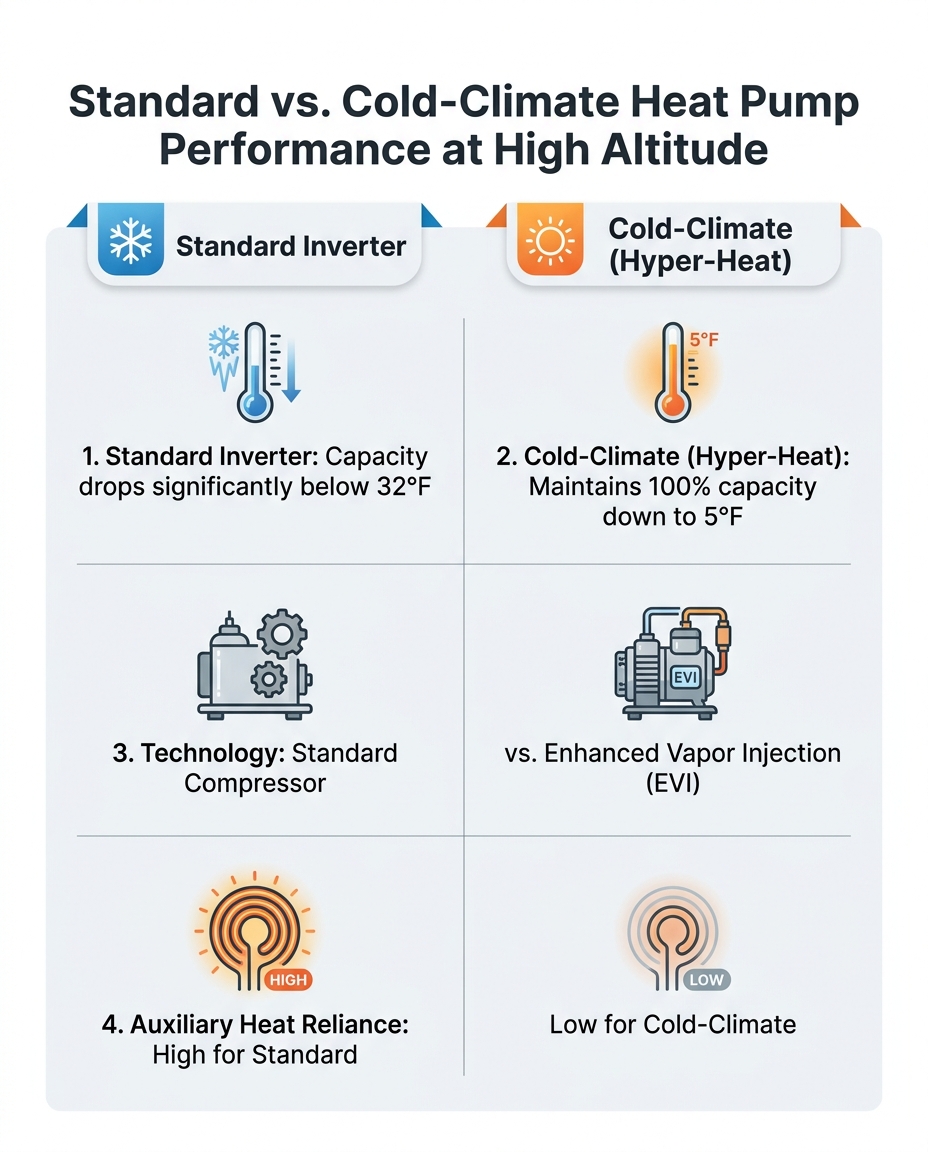
The performance drop of a standard inverter is not a slow, gradual decline; it is more like a cliff. Right around the 32-degree Fahrenheit mark (freezing), standard units begin to lose their heating capacity. By the time the temperature hits 15 degrees, a standard unit might only be able to provide 60% of its rated heating output.
This happens because of the physics of the refrigerant. The refrigerant in the outdoor coil must be colder than the outside air in order to absorb heat. When the outside air is 10 degrees, the refrigerant must be even colder. Compressing that ultra-cold vapor back into a high-temperature gas requires more work than a standard compressor can physically perform without overheating or shutting down on safety controls.
Cold-Climate Heat Pumps: The Hyper-Heat Advantage
This is where hyper-heat technology completely changes the game for mountain homes. Cold-climate heat pumps are specifically engineered to thrive in extreme sub-freezing lows. Instead of relying on a standard compression cycle, these advanced systems utilize a completely different mechanical process to ensure your home stays warm regardless of what the thermometer outside says.
The secret behind this performance is a technology called Enhanced Vapor Injection (EVI), often referred to as flash injection. This specialized compressor design allows the heat pump to maintain 100% of its rated heating capacity all the way down to 5 degrees Fahrenheit, and it can continue to operate efficiently at temperatures well below zero. Whether you are installing a central system or exploring ductless mini-splits for specific zones in your home, ensuring the equipment features a hyper-heat compressor is the only way to guarantee reliable winter performance.
By fundamentally changing how the refrigerant is handled inside the outdoor unit, cold-climate models bypass the mechanical limitations that cause standard inverters to fail. They are built with heavier-duty components, advanced defrost logic, and specialized sensors that constantly monitor the outdoor conditions to optimize the heating cycle for maximum efficiency.
How Flash Injection Conquers the Cold
To understand flash injection, it helps to compare it to a standard compressor. A standard compressor takes low-pressure vapor and squeezes it into high-pressure, high-temperature gas in one continuous stroke. In extreme cold, this single stroke is not enough to generate the necessary heat.
Flash injection acts like a turbocharger for your heat pump. It takes a portion of the liquid refrigerant, turns it into a vapor, and injects it directly into the compressor halfway through the compression cycle. This mid-cycle injection does two critical things: first, it cools the compressor motor, preventing it from overheating while it works overtime. Second, it significantly increases the mass flow rate of the refrigerant. More refrigerant mass moving through the indoor coil means more heat delivered to your living room, completely conquering the capacity cliff that plagues standard units.
Side-by-Side Performance: Standard vs. Cold-Climate in Mammoth Lakes
When you put these two technologies head-to-head in the context of our local mountain climate, the differences are striking. A standard system might look great on paper when viewing national averages, but the Mammoth Lakes / High Sierra altitude exposes its weaknesses rapidly. Choosing the right cold-climate heat pump means looking at how the equipment actually behaves when the first major winter storm rolls into the valley.
Below is a direct comparison of how these two distinct technologies handle the demands of a high-altitude winter.
• Minimum Operating Temperature — Standard Inverter Heat Pump: Typically shuts down or struggles below 15°F — Cold-Climate (Hyper-Heat) Model: Operates efficiently down to -13°F or lower
• Heating Capacity at 5°F — Standard Inverter Heat Pump: Drops to roughly 40-50% of rated capacity — Cold-Climate (Hyper-Heat) Model: Maintains 100% of its rated heating capacity
• Reliance on Auxiliary Heat — Standard Inverter Heat Pump: High reliance when temperatures drop below freezing — Cold-Climate (Hyper-Heat) Model: Rarely relies on auxiliary heat, saving significant energy
• High-Altitude Suitability — Standard Inverter Heat Pump: Poor; thin air exacerbates capacity loss — Cold-Climate (Hyper-Heat) Model: Excellent; EVI compensates for lower air density
The data makes it clear: a standard unit will leave you heavily dependent on backup heating sources, while a hyper-heat model is designed to carry the full heating load of your home independently, even during the coldest nights of the year.
Standard vs. Cold-Climate Heat Pump Performance at High Altitude
The Hidden Penalty of Auxiliary Heat Strips
When a standard heat pump fails to meet the heating demands of your home during extreme sub-freezing lows, it does not just stop working—it defaults to its backup system. For most homes, this means activating emergency electric resistance heat strips located inside the air handler. While these strips will keep your house warm, they come with a massive penalty to your overall energy efficiency.
The efficiency crash: Electric resistance heat operates with a COP of exactly 1.0. This means it creates one unit of heat for every one unit of electricity it consumes. It is essentially the same technology used in a giant toaster or a hairdryer. When your standard heat pump switches over to auxiliary heat, you lose all the energy-saving benefits that made you want a heat pump in the first place. Your system shifts from efficiently moving heat to expensively creating it from scratch.
The compounding frost issue: Furthermore, when a standard outdoor unit is struggling to extract heat from freezing air, the outdoor coil gets exceptionally cold. Any moisture in the air will rapidly freeze to the coil, creating a thick layer of frost. The system must then pause its heating cycle to run a defrost cycle, temporarily melting the ice. If you want to understand the mechanics behind this, learning why your heat pump might ice up during early frosts reveals how a struggling compressor spends more time defrosting than it does actually heating your home. A cold-climate model, with its robust compressor and advanced logic, manages frost accumulation far more effectively, keeping you comfortable without constantly falling back on those expensive heat strips.
October Urgency: Finalizing Your Heating Strategy Before the Snowpack
Time is of the essence when it comes to upgrading your heating equipment in the mountains. October serves as the absolute critical window for finalizing your winter strategy. Scheduling a mid-fall October pre-winter inspection gives you the necessary time to evaluate your current system, design a high-altitude replacement if needed, and get the equipment installed before the weather turns hostile.
Once the heavy Mammoth Lakes snow accumulation begins, the logistics of replacing an HVAC system become incredibly difficult, if not impossible. Outdoor units are often installed on elevated snow stands to keep them clear of the drifts, but accessing these locations mid-winter requires digging through feet of packed snow. Moving a heavy, 300-pound condenser across an icy, snow-covered yard is a massive safety hazard and logistical nightmare.
Securing a hyper-heat system design now ensures that your home is ready for whatever the season brings. Do not wait until your standard unit fails in the middle of a December blizzard. By taking action during the fall, you can secure comprehensive Mammoth Lakes HVAC services while the ground is still clear and the installation process is straightforward and safe.
Frequently Asked Questions About High-Altitude Heat Pumps
What is the difference between a standard and cold climate heat pump?
The primary difference lies in the compressor technology and how the system handles extreme cold. Standard heat pumps use basic compression that loses significant heating capacity as temperatures approach freezing. Cold climate heat pumps utilize advanced flash injection technology, allowing them to extract heat efficiently even when outdoor temperatures drop well below zero.
At what temperature do standard heat pumps stop working efficiently?
Standard heat pumps typically begin to lose their efficiency and heating capacity right around 32 degrees Fahrenheit. By the time the temperature reaches 15 degrees, their output drops drastically, forcing the system to rely heavily on expensive electric backup heating strips to keep the home warm.
Are cold climate heat pumps worth the investment?
Yes, especially in high-altitude, extreme-weather environments like the Eastern Sierra. The initial investment in a hyper-heat model is quickly offset by the massive energy savings gained by avoiding auxiliary heat strips. They provide consistent, reliable comfort without the massive efficiency penalties of standard units.
Do heat pumps work in Mammoth Lakes extreme cold?
Standard heat pumps struggle greatly in the Mammoth Lakes / High Sierra altitude and extreme cold, but cold-climate models are specifically designed for these conditions. Systems equipped with Enhanced Vapor Injection can maintain full heating capacity down to 5 degrees Fahrenheit and continue operating reliably in sub-zero weather.
What is a hyper-heat compressor and how does it work?
A hyper-heat compressor utilizes a technology called Enhanced Vapor Injection (EVI). It injects a portion of vaporized refrigerant directly into the compressor mid-cycle, which cools the motor and increases the mass flow rate. This allows the system to generate high-temperature heat even when the outside air is freezing thin.
How does high altitude affect heat pump performance?
High altitude reduces air density, meaning there is less physical air mass passing over the outdoor coil. Because a heat pump extracts thermal energy from the air, this thinner air makes it much harder for a standard system to capture enough heat. Specialized high-altitude designs compensate for this by moving more refrigerant and optimizing airflow.
Secure Your Winter Comfort with Eastern Sierra Experts
Understanding the difference between a Standard Inverter vs. Cold-Climate Heat Pumps: A Mammoth Lakes Performance Review is the first step toward a comfortable winter. Standard technology simply cannot keep up with the demands of our high-altitude climate. By scheduling a mid-fall October pre-winter inspection, you can ensure your home is equipped with the hyper-heat technology required to conquer the cold. Reach out to local professionals who understand exact elevation requirements, giving you the definitive, locally contextualized solution you need to stay warm all season long.
Sed iaculis aenean sit sed risus arcu vitae integer elit.
5 min read
Addressing Common Heating Failures in Round Valley Rural Properties
October cold snaps in the Eastern Sierra often expose hidden vulnerabilities in propane furnaces. See how local grid surges trigger unexpected lockouts and how to protect your rural heating system.
Standard Inverter vs. Cold-Climate Heat Pumps: A Mammoth Lakes Performance Review
Many homeowners believe any modern heat pump can handle a High Sierra winter. Discover why upgrading to a hyper-heat compressor is crucial before sub-zero temperatures hit.
Deciphering AFUE Ratings When Upgrading Your Furnace This Fall
Understanding how AFUE percentages translate to actual heating performance is critical before winter hits. See what an 80% versus a 90% rating really means for your fuel usage.