5 min read
Why Evaporative Coolers Lose Effectiveness During Late Summer Humidity Spikes
That sudden blast of warm, muggy air in August doesn't mean your swamp cooler is broken. The arrival of monsoon moisture changes the physics of home cooling.



At MCR Services Inc., when we help homeowners diagnosing short-cycling in Bishop air conditioners during late August heat, they are usually wondering why a system that ran perfectly in June is suddenly turning on and off every few minutes. The frustration is incredibly common this time of year as families transition into the back-to-school season. You set the thermostat to a comfortable temperature, but instead of a steady stream of cool air, the blower kicks on, runs for a fraction of its normal cycle, and abruptly shuts down. A few minutes later, the process repeats itself. Meanwhile, your home remains uncomfortably warm, and the indoor air starts feeling heavy and sticky.
This rapid on-and-off sequence is a symptom, not a disease. It signals a critical decision point for any homeowner: determining whether this late August / end-of-summer wear is the result of a simple, easily correctable airflow restriction, or if the system has sustained mechanical damage that requires advanced troubleshooting. In our experience, extreme late-summer conditions frequently push already-stressed components past their breaking point. After months of daily operation, parts that were slightly weak in the spring finally give out under the sustained thermal load.
Finding the root cause quickly is essential to protect the lifespan of your equipment. For comprehensive air conditioning services, understanding what is happening behind the vents is the first step toward restoring lasting comfort to your home.
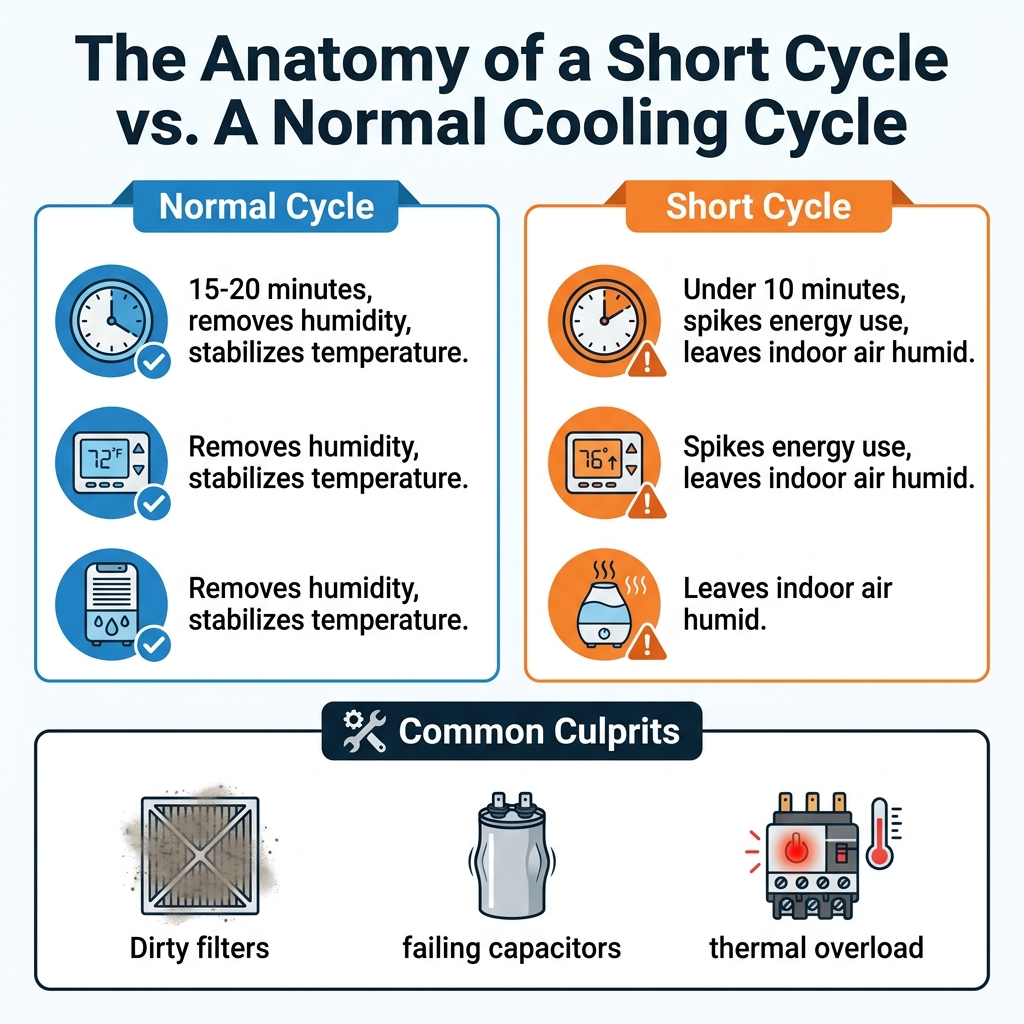
To understand why rapid cycling is so destructive, you have to look at how a cooling system is designed to operate. A normal, healthy air conditioning cycle typically lasts between 15 and 20 minutes, depending on the ambient temperature and the thermal load inside the house. During this window, the system is performing two distinct jobs: dropping the ambient air temperature and removing excess moisture from the indoor environment.
When short-cycling occurs, the compressor and blower shut down prematurely—often in under ten minutes. Because the cycle is truncated, the evaporator coil never has enough time to extract humidity from the air. You are left with a home that might register a cooler temperature on the thermostat, but feels clammy and uncomfortable due to the high moisture content.
The Hidden Cost of Constant Startups
The most severe consequence of a short cycle is the massive spike in energy consumption and mechanical strain. An air conditioning compressor draws an enormous amount of electrical current—often referred to as Locked Rotor Amps (LRA)—just to start spinning. Once it is running, the amperage drops significantly to a lower, steady rate. If your system is turning on and off six times an hour instead of two, you are multiplying that massive startup energy draw. This not only causes utility bills to skyrocket but also generates excessive heat within the compressor motor windings.
In most scenarios, short-cycling is actually a protective measure. Modern HVAC systems are equipped with various safety switches designed to shut the unit down before catastrophic damage occurs. If you need AC repair in Bishop, our technicians will typically start by identifying which safety switch tripped and why.
• Average Run Time — Normal Cooling Cycle: 15 to 20 minutes per cycle — Short-Cycling System: Under 10 minutes (often 2-5 minutes)
• Humidity Control — Normal Cooling Cycle: Excellent; coil has time to extract moisture — Short-Cycling System: Poor; air remains sticky and heavy
• Energy Consumption — Normal Cooling Cycle: Stable; standard startup draw followed by low running amps — Short-Cycling System: Severe spikes; constant high-amperage compressor startups
• Component Wear — Normal Cooling Cycle: Normal, predictable lifespan — Short-Cycling System: Accelerated fatigue on motors, contactors, and capacitors

The local climate plays a massive role in how and why cooling systems fail. The Bishop high-desert environment presents a unique set of challenges that significantly accelerate mechanical wear and tear, especially as the season drags on. By the time late August arrives, your outdoor condenser unit has likely endured hundreds of hours of continuous operation in 90-to-100-plus degree heat. This cumulative effect means that what appears to be a sudden, overnight breakdown is almost always the final result of weeks of invisible, mounting strain.
The Dual Threat of Heat and Dust
In a high-desert environment, extreme ambient temperatures are only half the battle. Fine desert dust, pollen, and airborne debris are constantly pulled into the outdoor condenser fins by the system's fan. Over the course of the summer, this particulate matter builds up, creating an insulating blanket over the aluminum fins. The primary job of the outdoor unit is to release the heat absorbed from inside your home into the outdoor air. When the coils are choked with dust, that heat transfer is severely restricted. The compressor has to work twice as hard, running hotter and longer, just to achieve the same cooling effect.
This environmental reality requires proactive planning. For example, our team recently worked with a local customer preparing a new lounge build-out this fall. They realized their existing setup couldn't handle the anticipated heat load of a crowded commercial space. We proactively updated their HVAC system to include robust, reliable AC specifically designed to accommodate these exact environmental demands, ensuring an on-time opening with a system that won't buckle under the desert heat.
Working with our crew at MCR Services Inc. means tapping into deep local expertise across Mammoth Lakes and Bishop. Understanding exactly how the high-desert climate impacts system longevity and performance allows us to provide more accurate diagnostics and longer-lasting repairs. We know firsthand that high-desert dust and late-summer thermal loads require specific attention to detail that generic maintenance often misses.
While electrical and mechanical repairs must always be left to licensed professionals, we always advise our customers that there are several safe, crucial diagnostic steps homeowners can take when a system begins to short-cycle. In our experience, the most common non-mechanical cause of rapid cycling in the Bishop high-desert environment is severely restricted airflow.
When air cannot flow freely over the indoor evaporator coil, the coil cannot absorb heat from the house. Without that heat transfer, the temperature of the refrigerant inside the coil drops rapidly. Eventually, the condensation on the outside of the coil freezes solid into a block of ice. Once the coil freezes, safety switches detect the abnormal pressure drop and shut the system down to protect the compressor. After the ice melts slightly, the system tries to turn on again, only to freeze and shut down shortly after—creating a classic short-cycle loop.
The Homeowner Troubleshooting Checklist:
• Inspect and replace the air filter: This is the single most important step. A filter that was clean in June is likely packed with dust, pet dander, and particulates by late August. If the filter looks gray or opaque, swap it out immediately.
• Check all supply registers: Walk through every room in the house and ensure that no furniture, rugs, or heavy curtains are blocking the floor or ceiling vents. Closing vents in unused rooms does not save energy; it increases static pressure and suffocates the blower.
• Examine the return air grilles: Ensure the large grilles where the system pulls air in are completely unobstructed.
• Look for visible ice: Safely inspect the copper refrigerant lines near your indoor unit. If you see frost or ice buildup, turn the thermostat to "OFF" and the fan setting to "ON" to help thaw the system.
If you have completed these steps, replaced a dirty filter, and allowed the system to rest, but the rapid cycling continues, you have ruled out simple airflow issues. At this point, the problem is mechanical. For a deeper look at keeping your system breathing freely, review a comprehensive AC maintenance checklist.
When our team is called out for end-of-season cooling failures, once airflow restrictions are ruled out, our focus shifts to the mechanical components that suffer the most during late August / end-of-summer wear. Continuous operation in high ambient temperatures drastically reduces the lifespan of critical electrical parts, most notably the motor run capacitors.
The Role of the Run Capacitor
A run capacitor functions much like a high-powered battery. It stores electrical energy and delivers a massive jolt to the compressor and fan motors to help them start, and then provides a continuous, smooth electrical current to keep them running efficiently. Capacitors are highly sensitive to heat. Months of baking in the high-desert sun, combined with the internal heat generated by the system, causes the dielectric fluid inside the capacitor to break down. When a capacitor begins to fail, the compressor struggles to start. It may pull too much amperage, overheat, and trigger a safety shutdown before the cooling cycle is complete.
Thermal Overload Protection
Inside the dome of the compressor is a thermal overload switch. This is a fail-safe device designed to break the electrical circuit if the compressor motor gets too hot. If the outdoor coil is packed with dirt, or if the refrigerant charge is slightly low, the compressor loses its ability to cool itself with returning refrigerant. The thermal overload switch trips, shutting the system down. Once the compressor cools off—which can take several hours in the summer heat—the switch resets and the system tries to run again, resulting in a delayed short-cycle pattern.
A Strict Warning on DIY Diagnostics
While checking a filter is safe, testing capacitors, bypassing safety switches, or checking refrigerant pressures is highly dangerous. Capacitors can store lethal amounts of voltage even when the main power is disconnected. Refrigerant handling is strictly regulated by federal law and requires specialized gauges and recovery equipment. If your system is experiencing component fatigue, professional AC maintenance and diagnostic testing are the only safe paths forward.
This rapid cycling is usually caused by the system overheating and triggering a safety shutoff. When the ambient temperature is extremely high, components like the compressor have to work much harder to reject heat. If there is any underlying issue—such as a dirty filter restricting airflow, a failing capacitor, or a dirty outdoor coil—the system quickly overheats and shuts down to prevent catastrophic damage. Once it cools slightly, it attempts to restart, creating the rapid on-and-off loop.
Yes, prolonged high temperatures can absolutely cause an air conditioner to short cycle. Every cooling system is designed with a maximum operating temperature threshold. During prolonged high-desert heatwaves, the compressor runs hotter than normal. If the heat becomes too intense, internal thermal overload switches will force the system off to prevent the motor windings from melting or sustaining permanent damage.
Short cycling is extremely bad for an air conditioning unit. It causes excessive, accelerated wear on the compressor, contactors, and electrical components because the system is forced to endure the high-amperage stress of startup repeatedly. Furthermore, it leads to significantly higher energy bills and often results in premature, complete system failure if the root cause is not addressed quickly.
Start by changing the air filter and checking all rooms to ensure supply and return vents are completely unblocked. Restricted airflow is the most common homeowner-fixable cause. If changing the filter and thawing any visible ice does not resolve the issue, you must turn the system off at the thermostat and call a licensed professional, as the problem is likely electrical or refrigerant-related.
The most common signs of a failing capacitor include a loud humming or buzzing noise coming from the outdoor unit, the outdoor fan failing to spin (or spinning very sluggishly), and the system shutting down quickly after trying to start. Capacitors are highly sensitive to cumulative heat strain, making late August / end-of-summer wear a prime time for these components to bulge, leak, or fail entirely.
Our team highly recommends calling a professional immediately if basic filter changes and unblocking vents do not stop the short-cycling behavior. Continuing to run a system that is rapidly turning on and off can permanently kill the compressor—the most expensive component in your entire system. A licensed professional from MCR Services Inc. has the tools to safely test the high-voltage electrical components and measure refrigerant pressures accurately.
Ignoring a short-cycling air conditioner is a fast track to replacing a compressor. What starts as a relatively straightforward issue—like a failing capacitor or a dirty condenser coil—can quickly escalate into a total system failure if the equipment is allowed to continually hammer itself on and off. The late August / end-of-summer wear is a critical time for HVAC systems, and pushing a struggling unit through the final heat waves of the year often results in permanent damage.
Our local experts at MCR Services Inc. understand exactly how the high-desert climate impacts your equipment. If you need AC repair in Bishop, you can rest assured that our experienced technicians recognize the specific signs of thermal fatigue and dust insulation that plague systems in this region. Don't let a minor electrical issue turn into a major replacement project (and remember, if a replacement is needed, generic federal tax credits or utility incentives may apply to qualifying high-efficiency heat pump installations, so always check with your utility provider). Schedule a late summer AC tune-up and diagnostic inspection with our team to safely identify the root cause, protect your compressor, and restore reliable, consistent comfort to your home.