5 min read
Why Evaporative Coolers Lose Effectiveness During Late Summer Humidity Spikes
That sudden blast of warm, muggy air in August doesn't mean your swamp cooler is broken. The arrival of monsoon moisture changes the physics of home cooling.



Your home felt perfectly chilled in June, but now the vents are blasting warm, sticky air into every room. If you are wondering why evaporative coolers lose effectiveness during late summer humidity spikes, the simple truth is that your equipment might not be broken at all. The sudden arrival of August monsoon moisture changes the rules of cooling, transforming a system that worked flawlessly weeks ago into a frustrating source of indoor mugginess.
Many homeowners assume a sudden drop in cooling performance means a pump has failed or a belt has snapped. While mechanical failures do happen, late-summer cooling issues are often strictly environmental. The sudden shift in late-summer weather patterns forces homeowners to realize their cooling system is entirely weather-dependent. When the outside air becomes saturated with moisture, the physical process that makes a swamp cooler work simply stops functioning.
This leaves you at a frustrating decision point: continue suffering through sticky indoor conditions, or reconsider the home's long-term cooling strategy. Modern alternatives exist that actively manage indoor climates regardless of outside weather. If you are ready to move past the limitations of evaporative cooling, upgrading to a ductless mini-split installation provides consistent, reliable comfort even on the muggiest days of the year.
To understand why your system struggles late in the season, you first need to understand why it works so well early in the season. Throughout June and July, the typically arid, dry climate of the Mammoth Lakes and Eastern Sierra region makes evaporative cooling a historically popular and highly efficient choice. The process relies entirely on the outside air being dry enough to absorb additional water.
The mechanics of evaporative cooling are straightforward but heavily dependent on atmospheric conditions. Unlike modern air conditioning systems that use chemical refrigerants to move heat, a swamp cooler relies on basic natural physics. Here is the step-by-step process of how your system creates cold air:
1. Air Intake: A large blower fan pulls hot, dry outside air into the unit housing.
2. Water Saturation: A pump continuously circulates water over thick, porous cooling pads, keeping them completely soaked.
3. Heat Absorption: As the hot, dry air passes through the wet pads, the water evaporates. This phase change (from liquid to gas) requires energy, which it pulls from the heat in the air.
4. Air Distribution: The newly cooled, moisture-heavy air is forced through your ductwork and into your living spaces.
This process highlights a critical distinction in thermodynamics: sensible heat versus latent heat. Sensible heat is the temperature you can actually feel and measure with a standard thermometer. Latent heat is the energy stored in the moisture of the air. An evaporative cooler lowers the sensible heat (dropping the temperature) by adding latent heat (moisture) to the air. This mechanical process relies entirely on the outside air being dry enough to accept that new moisture.
HVAC professionals use a specific metric called "wet-bulb temperature" to determine how well an evaporative cooler will perform. In simple terms, the wet-bulb temperature is the absolute lowest temperature the air can reach through water evaporation alone. You can think of it as the cooling limit of the atmosphere on any given day.
During a dry early-summer afternoon, the standard air temperature (dry-bulb) might be 95°F, but the wet-bulb temperature might only be 60°F because the air is so dry. That massive gap guarantees a high cooling capacity for swamp coolers, allowing them to easily drop the air temperature blowing into your home by 20 to 30 degrees. However, when the wet-bulb temperature rises due to incoming weather systems, that cooling capacity shrinks dramatically.
Evaporative coolers do not gradually lose efficiency; they hit a hard mechanical wall. This threshold failure is directly tied to specific weather events, particularly the August monsoon moisture surges that periodically saturate the local atmosphere. When relative humidity rises, the physics of evaporation break down.
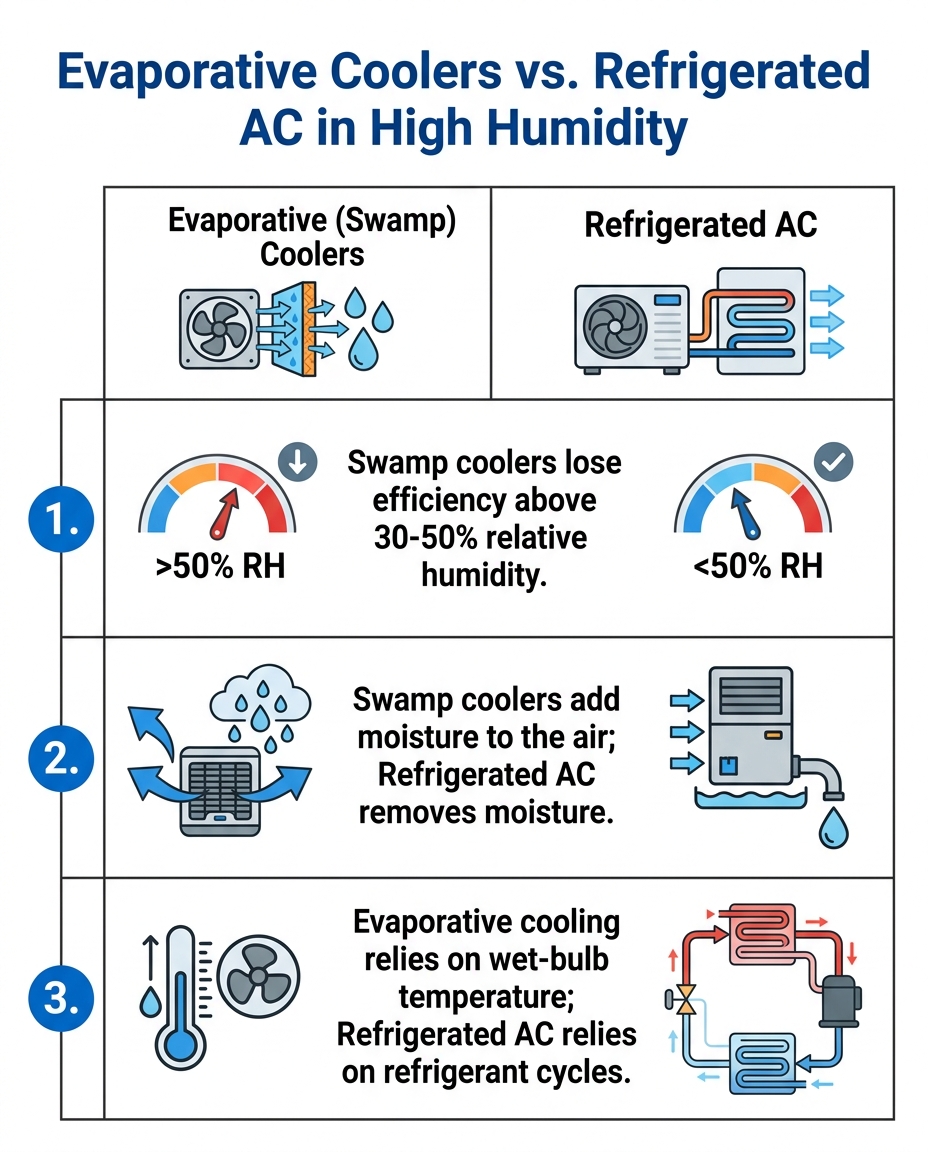
For a swamp cooler to operate efficiently, outside relative humidity needs to stay below 30% to 50%. Once humidity climbs past that threshold, the outside air is already holding a significant amount of water vapor. Because the air is partially saturated, it cannot absorb water from the cooler's pads as quickly. The slower the evaporation, the less heat is removed from the air.
While relative humidity is a common metric, dew point is actually a better indicator of swamp cooler failure. Dew point measures the absolute amount of moisture in the air. When the dew point creeps into the 55°F to 60°F range, the air feels heavy and sticky. At these levels, your swamp cooler stops cooling the air and simply blows hot, damp air directly into your living space.
To visualize this limitation, consider a standard kitchen sponge. If you wipe up a spill with a bone-dry sponge, it soaks up the liquid instantly. But if you try to wipe up a spill with a sponge that is already soaking wet, you just push the water around the counter. The atmosphere acts the exact same way.
At 70% humidity and above, the atmospheric "sponge" is full. Evaporation becomes nearly impossible. Your swamp cooler's water pump is still running, and the fan is still spinning, but no phase change is happening on the pads. The system becomes highly ineffective and essentially functions as a large, noisy, and expensive fan pulling humid outdoor air directly into your home.

The Problem: When the house gets hot and uncomfortable, the immediate psychological reaction is to walk over to the thermostat or control switch and turn the swamp cooler to its highest setting. Homeowners assume that more airflow will eventually break through the heat and cool the house down.
The Cause: In a dry climate, increasing the fan speed pushes more cooled air into the home. But during periods of high humidity in the Mammoth Lakes and Eastern Sierra region, turning up the cooler actively works against you. Because the air cannot evaporate the water on the pads, the system is no longer cooling. Instead, forcing a swamp cooler to run on "High" during a monsoon surge actively pumps gallons of water vapor into a house that is already saturated.
The Solution: You have to recognize when the system is working against you. Continuing to run the cooler creates a miserable "sauna effect" inside the home. The indoor air becomes so heavy with moisture that your sweat cannot evaporate, making you feel much hotter than the actual room temperature. You will start to notice secondary issues: interior doors swelling and sticking in their frames, bed sheets feeling damp to the touch, and a heavy, oppressive mugginess in every room.
Furthermore, this excessive indoor moisture degrades your indoor air quality. Prolonged high humidity creates an ideal breeding ground for mold and mildew inside your walls and ductwork. It also puts unnecessary strain on the equipment's motor and belts as it runs non-stop without ever satisfying the thermostat's temperature request. When the weather turns humid, the best immediate solution is often to turn off the water supply to the cooler, run it in "fan only" mode to circulate air, and open windows to prevent moisture buildup.
Because late-summer weather patterns are unpredictable, it can be difficult to tell if your system actually needs a repair or if it is simply structurally incapable of handling the current weather. Before scheduling a service call, you can perform a few basic observations to determine the root cause of your warm air.
• Airflow Temperature — Mechanical Failure: Blowing warm, dry air — Environmental Limitation: Blowing warm, heavily humid air
• Cooling Pads — Mechanical Failure: Bone dry or heavily calcified — Environmental Limitation: Completely saturated with water
• Outside Weather — Mechanical Failure: Clear, dry, and low humidity — Environmental Limitation: Overcast, muggy, high dew point
• Recent Performance — Mechanical Failure: Gradual decline over several weeks — Environmental Limitation: Worked perfectly yesterday, failing today
If the outside air is dry but your system is still failing to cool the home, you likely have a mechanical issue. Look for specific symptoms that warrant a professional look. If the cooling pads are dry, the water pump may have failed, or the distribution spider tubes might be clogged with hard water scale. If you hear the motor running but feel no air coming from the vents, a fan belt has likely snapped or slipped off its pulley. In these scenarios, scheduling prompt AC repair services can restore your system's performance quickly. A professional can confirm if the unit is operating at peak capacity despite the weather, or if a worn-out component is holding it back.
If your system was working flawlessly a month prior, the water pump is functioning, the pads are wet, and the fan is spinning—but the air inside feels like a damp jungle—the issue is the weather, not the machine. The August monsoon moisture has simply overpowered the system's design limits. When you find yourself facing this exact scenario year after year, it is time to discuss the long-term viability of relying on a weather-dependent system. Transitioning to a modern setup through AC replacement in Bishop eliminates the uncertainty of evaporative cooling and puts you back in control of your indoor comfort.
Once you understand that evaporative coolers are fundamentally limited by humidity, the solution becomes clear: you need a system that actively removes moisture rather than adding it. This is where the transition to modern refrigerated air conditioning transforms a home. Unlike swamp coolers, which add latent heat to the air, refrigerated systems are designed to actively pull both sensible heat and latent heat out of your living spaces.
Modern air conditioning systems use a closed-loop refrigerant cycle. Warm indoor air is pulled across an indoor evaporator coil that is filled with cold refrigerant. As the air passes over the coil, the heat is absorbed, and the moisture in the air condenses on the cold metal—just like water droplets forming on the outside of a cold glass of ice water on a summer day. That condensation is then safely drained outside, leaving the air returning to your rooms crisp, cool, and perfectly dry.
For homes in the Mammoth Lakes and Eastern Sierra region that lack traditional ductwork, ductless mini-splits offer a highly efficient, tailored solution. Bringing deep local microclimate expertise to every installation, we understand that homes transitioning away from swamp coolers need equipment that can handle sudden weather shifts. Mini-splits provide consistent comfort regardless of outside humidity, allowing you to set a precise temperature and let the system do the rest. This is exactly why we recommend replacing swamp coolers with ductless mini-splits for homeowners tired of the late-summer sauna effect.
Beyond their superior cooling and dehumidification capabilities, modern heat pump mini-splits offer the added benefit of dual functionality. They provide powerful cooling during sticky summer monsoons and reverse their operation to provide highly efficient heating during the freezing winter months. By upgrading your technology, you eliminate the seasonal frustration of weather-dependent cooling and secure year-round comfort for your home.
At what humidity does a swamp cooler stop working?
A swamp cooler begins losing significant efficiency when outside relative humidity reaches 30% to 50%. Once humidity climbs to 70% or higher, the air is too saturated to absorb additional moisture, and the cooling effect stops completely. At this point, the system acts as a large fan blowing humid air into the home.
Why is my swamp cooler blowing warm air in August?
Late-summer monsoon moisture surges drastically raise the outdoor dew point and humidity levels. Because evaporative cooling requires dry air to function, this sudden influx of moisture prevents the water on the cooler's pads from evaporating. Without evaporation, no heat is removed from the air, resulting in warm airflow.
Does a swamp cooler make the house humid?
Yes, swamp coolers actively add moisture to your indoor air as part of their normal operation. During dry weather, this added moisture is often comfortable and prevents dry skin. However, during humid weather, this process quickly oversaturates the home, leading to dampness, swelling doors, and poor indoor air quality.
How can I make my swamp cooler colder in high humidity?
Unfortunately, you cannot force a swamp cooler to blow colder air when the outside humidity is high, as the system is limited by the laws of physics. Turning the fan speed up will only pump more water vapor into your home, making it feel hotter. The best approach during high humidity is to turn off the water pump and run the fan alone to circulate air, while opening windows to exhaust trapped moisture.
What is wet-bulb temperature and why does it affect evaporative cooling?
Wet-bulb temperature is the lowest temperature the air can reach strictly through the evaporation of water. Evaporative coolers rely entirely on this metric; a low wet-bulb temperature means high cooling potential. When humidity rises, the wet-bulb temperature gets closer to the actual air temperature, leaving the cooler with very little capacity to drop the temperature.
Should I switch to refrigerated air conditioning to handle late-summer moisture?
Switching to a refrigerated system, such as a ductless mini-split, is the most effective way to handle late-summer moisture. Unlike swamp coolers that add humidity, refrigerated systems actively pull moisture out of the indoor air and drain it outside. This provides consistent, dry, and comfortable cooling regardless of how muggy the weather gets outdoors.