The Mechanics of Carbon Monoxide Detection in Tightly Sealed Winter Cabins
The Mechanics of Carbon Monoxide Detection in Tightly Sealed Winter Cabins
The Hidden Risks of Weatherproofing Ahead of the Winter Freeze
Before the first mountain snowstorm arrives, understanding the mechanics of carbon monoxide detection in tightly sealed winter cabins is one of the most critical safety steps you can take. The September pre-heating season naturally brings a rush of preparation. Our team at MCR Services Inc. sees it every year: you add weatherstripping to the doors, caulk the window frames, and perhaps upgrade your attic insulation. The goal is simple and sensible: keep the freezing temperatures out and the expensive heat inside.
However, in our experience servicing mountain homes, we've noticed that this aggressive weatherproofing creates an unintended consequence for your indoor air quality. When you seal a cabin to maximize energy efficiency, you also trap indoor air. If you rely on aging HVAC systems or traditional combustion heaters, trapping that air becomes a serious liability. Older furnaces require a constant supply of fresh oxygen to burn fuel cleanly and safely. When a home is tightly sealed, the natural draft pathways disappear.
The core problem: As your heating equipment runs, it slowly consumes the available oxygen in the house. Without proper ventilation, the combustion process becomes starved of air, leading to the production of dangerous combustion gases. Because modern insulation is so effective at preventing drafts, these toxic gases have nowhere to go but into your living spaces.
This dynamic forces a crucial decision point for homeowners. Standard store-bought alarms are simply not calibrated for the realities of a heavily winterized, airtight home. To protect your family, upgrading to specialized monitoring systems that can detect minute shifts in air quality is no longer just an option—it is a necessity for modern mountain living.
How High Altitude Alters Furnace Combustion
The physics of heating a home change dramatically as you climb in elevation. Mammoth Lakes sits at nearly 8,000 feet above sea level, which fundamentally alters how heating equipment breathes and operates compared to sea-level environments. At this altitude, the atmospheric pressure is significantly lower, meaning the air is thinner and less dense.
Because the air is less dense, there is less oxygen available in every cubic foot of air your furnace pulls in. Combustion appliances are generally calibrated at the factory for sea-level operation, where oxygen is plentiful. When our technicians service these same units in Mammoth Lakes high-altitude cabins, we see firsthand how they inherently struggle to achieve complete combustion. The baseline risk of producing harmful byproducts is naturally elevated simply because of the geography.
When an aging furnace operates in an oxygen-deprived environment, the fuel does not burn completely. The chemical byproduct of this incomplete combustion is carbon monoxide (CO)—an odorless, colorless, and highly toxic gas. Relying on standard heating assumptions that apply to coastal or valley homes is dangerous when you live in the mountains.
The Science of Incomplete Combustion
To understand why this happens, you have to look at the oxygen-to-fuel ratio required for safe heating. A healthy furnace mixes fuel (like propane or natural gas) with a specific volume of oxygen to create a clean, blue flame. The primary byproducts of a clean burn are water vapor and carbon dioxide, which safely vent outside.
What disrupts the ratio:
• Lower air density: Less oxygen per breath the furnace takes.
• Burner wear and tear: Rust or debris on aging burners disrupts the smooth flow of gas.
• Clogged air intakes: Dust or snow blocking the fresh air supply forces the system to choke.
When the oxygen-to-fuel ratio drops, the flame burns cooler and often appears yellow or orange. Instead of producing harmless carbon dioxide, the chemical reaction stops halfway, producing carbon monoxide. In a high-altitude setting, even a minor lack of maintenance on an older furnace can push the system into incomplete combustion rapidly. This is exactly why our specialized Mammoth Lakes heating services always focus heavily on burner calibration and combustion analysis.
The Unintended Consequence of Aggressive Weatherproofing
When you combine the high-altitude combustion challenges with a lack of ventilation, the situation compounds quickly. Freezing temperatures and heavy snow naturally prompt residents to seal every draft, inadvertently creating a vacuum effect inside the cabin. To understand how this traps carbon monoxide, you have to look at the dynamics of indoor air pressure.
A house breathes. In an older, drafty home, air escapes through gaps in the windows and is replaced by fresh air seeping in through the floorboards or walls. This continuous air exchange dilutes any minor indoor pollutants. However, in tightly sealed Mammoth Lakes high-altitude cabins, this natural air exchange stops completely. When your furnace, water heater, or bathroom exhaust fans run, they push air out of the house. Because the cabin is sealed, no fresh air can easily enter to replace it.
This creates negative air pressure. The house is literally starving for air, and physics dictates that it will pull replacement air from the path of least resistance. Often, that path is straight down the furnace or water heater exhaust flue. This is a critical issue that makes routine heating system maintenance so important before the deep freeze sets in.
Negative Air Pressure and Backdrafting
Backdrafting is the scientific term for what happens when exhaust gases reverse direction. Instead of hot, toxic combustion gases rising safely up the chimney or flue and venting outdoors, the negative pressure inside the cabin sucks those gases right back into the utility room or basement.
The mechanics of a backdraft:
• The trigger: An exhaust fan, dryer, or fireplace pulls air out of the sealed home.
• The vacuum: The indoor air pressure drops below the outdoor air pressure.
• The reversal: The furnace exhaust flue, which should carry gases outside, becomes an intake vent.
• The result: Carbon monoxide spills directly into the mechanical room and circulates through your ductwork.
Because sealed windows and modern spray-foam insulation eliminate natural draft pathways, the lack of fresh air exchange accelerates the buildup of these toxic gases. What might have been a minor, harmless puff of exhaust in a drafty 1970s home becomes a concentrated, circulating hazard in a modernized winterized cabin.
Standard Alarms vs. Low-Level Monitors: Understanding the Thresholds
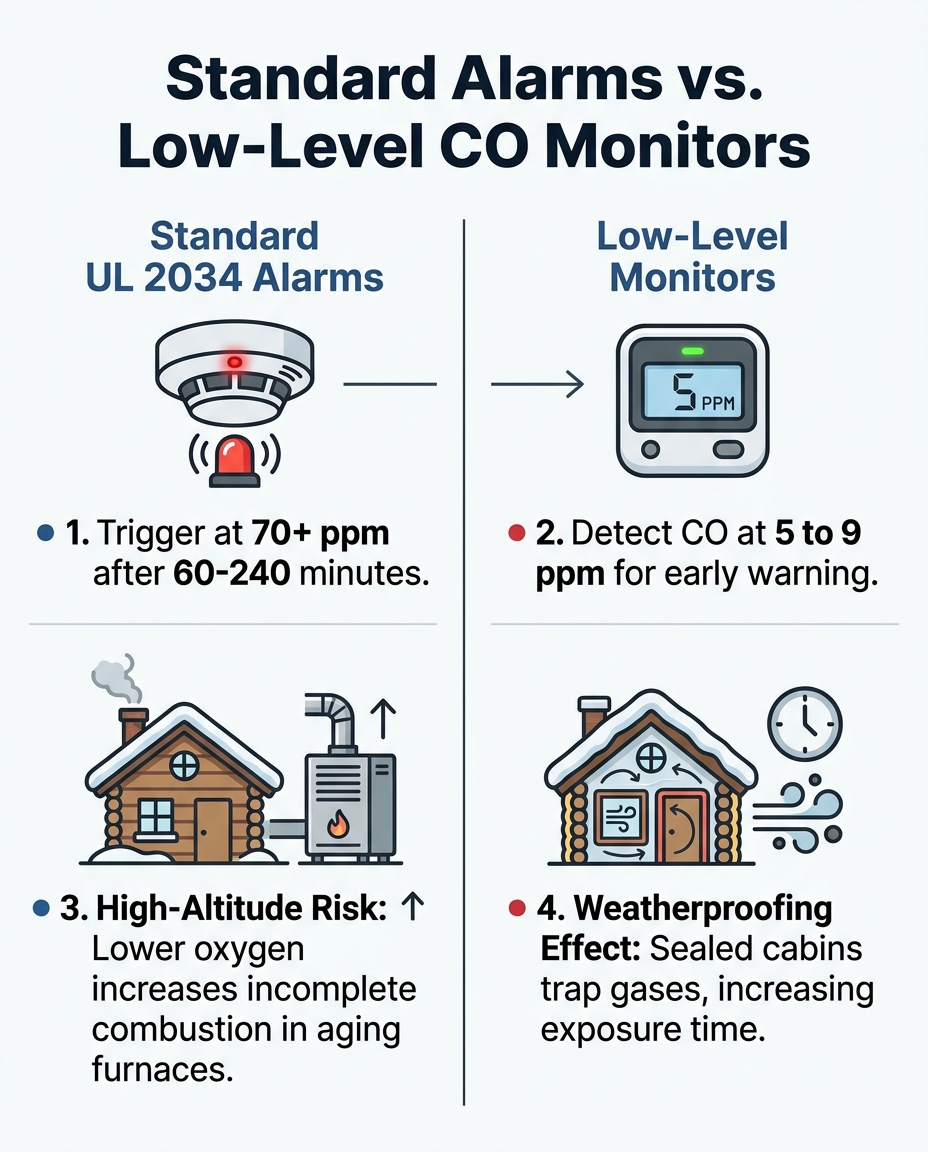
During our fall heating tune-ups, our team frequently finds that most homeowners purchase carbon monoxide alarms from the local hardware store, install them in the hallway, and assume they are fully protected. However, there is a critical difference between standard UL 2034 alarms and true low-level monitors. Understanding these thresholds is the key to protecting your family in a tightly sealed environment.
The UL 2034 standard governs almost all store-bought CO alarms. Under this standard, the device is explicitly designed to prevent acute, life-threatening emergencies in healthy adults. It is not designed to detect slow leaks or chronic low-level issues. In fact, a standard UL 2034 alarm will typically remain completely silent even if there is a steady presence of 30 or 40 parts per million (ppm) of carbon monoxide in your home.
For a standard alarm to sound, the CO levels often must reach 70 ppm and remain there for anywhere from 60 to 240 minutes. If the level hits 400 ppm, the alarm will sound in 4 to 15 minutes. This high threshold exists to prevent false alarms from temporary spikes, like burning toast or briefly idling a car in an attached garage. However, in a sealed cabin, a steady, slow leak from a backdrafting furnace can cause severe health issues long before the standard alarm ever makes a sound.
Why 70 PPM is Too High for Early Warning
The gap between safe indoor air quality and the 70 ppm trigger is massive. The Environmental Protection Agency (EPA) and various health organizations note that long-term low-level CO exposure (under 70 ppm) can cause significant health problems, especially for infants, the elderly, or anyone with a preexisting heart or respiratory condition.
• Detection Threshold — Standard UL 2034 Alarm: Triggers at 70+ ppm. — Low-Level CO Monitor: Detects as low as 5 to 9 ppm.
• Response Time (at 70 ppm) — Standard UL 2034 Alarm: 60 to 240 minutes. — Low-Level CO Monitor: Almost immediate visual or audio alert.
• Primary Purpose — Standard UL 2034 Alarm: Prevent acute poisoning and death. — Low-Level CO Monitor: Provide early warning of slow leaks and chronic exposure.
• Display Screen — Standard UL 2034 Alarm: Often blank until high levels are reached. — Low-Level CO Monitor: Continuously displays real-time ambient levels.
• Best Use Case — Standard UL 2034 Alarm: Drafty homes at sea level. — Low-Level CO Monitor: Tightly sealed, high-altitude winter cabins.
Standard store-bought alarms provide a false sense of security. They tell you when you need to evacuate immediately to save your life, but they do not tell you if your furnace has been slowly poisoning your air supply for the last three weeks. Low-level CO monitors, on the other hand, detect carbon monoxide at levels as low as 5 to 9 ppm. They give you the early warning necessary to call a professional long before you ever feel sick.
Standard Alarms vs. Low-Level CO Monitors
The Danger of Chronic, Low-Level Carbon Monoxide Exposure
Understanding the health and safety implications of long-term exposure to low levels of CO is essential for anyone spending the winter in the mountains. Chronic low-level exposure differs significantly from acute poisoning. Acute poisoning happens rapidly—usually from a massive leak or a car running in a closed garage—and causes immediate unconsciousness. Chronic exposure happens slowly, subtly, and over a long period of time.
When you breathe in carbon monoxide, it binds to the hemoglobin in your blood much faster than oxygen does. This essentially starves your brain and vital organs of the oxygen they need to function. In a tightly sealed cabin, continuous low-level CO exposure (under 70 ppm) compounds over days and weeks. Your body never gets a break to flush the toxin out with fresh air.
The subtle symptoms of low-level exposure include:
• Persistent dull headaches: Often worse when you wake up in the morning.
• Mild nausea or dizziness: Especially when moving around the house.
• Shortness of breath: Feeling winded from minor physical exertion.
The greatest danger of these symptoms is how easily they are misdiagnosed. In a mountain town, a headache, fatigue, and slight nausea are almost always written off as altitude sickness, dehydration, or a standard winter cold. Homeowners often take pain relievers and go back to bed—right back into the environment that is making them sick. This is why knowing what a burning smell means when you turn on your furnace, and having a monitor sensitive enough to detect the problem early, is vital for vulnerable populations like children and the elderly.
Proactive Safety Measures for Aging Heating Equipment
Relying on an alarm to sound is a reactive strategy. The safest way to handle the intersection of high-altitude physics, aging equipment, and modern weatherproofing is to take proactive, professional steps before the heavy winter season sets in. The September pre-heating season is the optimal time to address these risks.
Working with our localized high-altitude heating experts here at MCR Services Inc. ensures that your proactive winter safety maintenance accounts for the unique regional air pressure and combustion dynamics we experience in the mountains. A generic checklist is not enough when you live at 8,000 feet.
Here are the actionable steps to secure your cabin:
1. Schedule a comprehensive combustion inspection: Have a professional evaluate your aging furnace and exhaust flues. They will use specialized combustion analyzers to check the exact oxygen-to-fuel ratio and measure the drafting pressure of the flue to ensure gases are venting outward, not inward.
2. Upgrade your detection hardware: Remove standard store-bought alarms and install low-level CO monitors in strategic locations. Place one in the mechanical room, one in the main living space, and one near the sleeping quarters. Ensure they have digital displays so you can monitor real-time ambient levels.
3. Verify makeup air pathways: A professional will check your ventilation pathways to ensure your combustion appliances have proper makeup air. If your cabin is too tightly sealed, they may recommend installing a dedicated fresh air intake pipe that feeds directly to the furnace burner, bypassing the sealed living space entirely.
4. Establish a consistent maintenance schedule: Routine professional oversight is far more effective than relying solely on alarms. We highly recommend enrolling in a routine maintenance plan, which guarantees that your system is cleaned, calibrated, and safety-tested by our professionals every single fall before the freezing temperatures lock you indoors.
Frequently Asked Questions About Carbon Monoxide Detection
At what level does a standard carbon monoxide detector go off?
A standard UL 2034 carbon monoxide detector typically will not sound until CO levels reach 70 ppm for a sustained period of 60 to 240 minutes. If the concentration spikes to 400 ppm, the alarm will trigger much faster, usually within 4 to 15 minutes. These devices are intentionally designed with high thresholds to prevent false alarms from minor, temporary household activities. However, this means they will not alert you to chronic low-level CO exposure (under 70 ppm) that can still cause significant health issues over time.
Why do tightly sealed homes have higher carbon monoxide risks?
Tightly sealed homes restrict the natural exchange of indoor and outdoor air, which traps pollutants inside. When exhaust fans, dryers, or furnaces operate in an airtight space, they create negative indoor air pressure. This vacuum effect can pull toxic combustion gases down the exhaust flues and back into the living areas—a process known as backdrafting. Without drafts or fresh air intake, those trapped gases quickly accumulate to dangerous levels.
What is the difference between a standard CO alarm and a low-level monitor?
The primary difference lies in their sensitivity and response time. A standard CO alarm is designed to prevent life-threatening emergencies and often ignores continuous low-level exposure below 70 ppm. A low-level monitor is highly sensitive, designed to detect and display carbon monoxide concentrations as low as 5 to 9 ppm. Low-level monitors provide an early warning system, allowing you to address a failing furnace long before the air becomes acutely toxic.
How does high altitude affect furnace carbon monoxide emissions?
High altitude significantly reduces air density, meaning there is less oxygen available for the combustion process. Furnaces require a precise mixture of fuel and oxygen to burn cleanly. When an aging furnace operates in an oxygen-deprived mountain environment, it struggles to achieve complete combustion. This incomplete burn directly results in higher baseline emissions of carbon monoxide compared to the same furnace operating at sea level.
Why do carbon monoxide detectors commonly go off in winter?
Carbon monoxide detectors frequently sound in winter because homes are sealed tight against the cold, and heating appliances are running at maximum capacity. Windows and doors stay shut, eliminating natural ventilation that would normally dilute indoor air. Additionally, heavy snow or ice can physically block exterior exhaust vents, forcing combustion gases to back up into the mechanical room and trigger the alarms.
Where should low-level CO monitors be placed in a winter cabin?
Low-level CO monitors should be placed strategically to provide the earliest possible warning. Install one in the same room as your primary heating equipment, about 10 to 15 feet away from the furnace to avoid false alerts from initial startup puffs. Additionally, place monitors in the main living areas and immediately outside all sleeping quarters. Because carbon monoxide mixes evenly with indoor air, placing them at knee-to-chest height allows you to easily read the digital display.
Prioritize Early Detection Before the Freezing Temperatures Arrive
The mechanics of carbon monoxide detection in tightly sealed winter cabins reveal a complex intersection of high altitude, aging furnaces, and modern weatherproofing. While sealing your home against the cold is necessary for comfort and efficiency, it fundamentally alters the indoor air pressure. During the September pre-heating season, taking the time to understand how backdrafting occurs and why standard alarms fall short can prevent a quiet tragedy.
Relying on a standard alarm that waits for 70 ppm to sound leaves your family vulnerable to the subtle, compounding dangers of chronic exposure. Upgrading to low-level CO monitors provides true peace of mind, giving you real-time data on your indoor air quality. Before the deep freeze locks you indoors for the season, consult with our local high-altitude heating experts at MCR Services Inc. to evaluate your cabin's safety. A thorough combustion analysis and a monitor upgrade offer the scientific certainty and actionable protection you need to enjoy the mountain winter safely.
Sed iaculis aenean sit sed risus arcu vitae integer elit.
5 min read
Why Your Heat Pump Might Ice Up During Early Fall Frosts
Finding frost on your outdoor unit in September often triggers panic about a major breakdown. Discover the difference between a normal seasonal defrost cycle and a true refrigerant leak.
The Mechanics of Carbon Monoxide Detection in Tightly Sealed Winter Cabins
Weatherproofing your cabin for winter traps heat, but it also traps dangerous combustion gases from aging furnaces. See why low-level monitors are essential for safety.
Winterizing Mobile Home HVAC Systems Against Bishop's Freezing Nights
Standard residential heating checklists ignore the exposed underbellies of manufactured housing. Protect your mobile home's ductwork before the first hard freeze hits the Eastern Sierra.