Why Your Heat Pump Might Ice Up During Early Fall Frosts
Why Your Heat Pump Might Ice Up During Early Fall Frosts
Is It Normal for a Heat Pump to Ice Up in September?
Have you ever walked outside on a crisp autumn morning and wondered why your heat pump might ice up during early fall frosts? Waking up to find a layer of white frost coating your outdoor unit is one of the most common sources of homeowner anxiety as the seasons begin to shift. You rely on your heating system to keep your home comfortable, and seeing ice on the metal coils in September often triggers an immediate panic about a catastrophic breakdown before winter has even officially arrived. It is incredibly stressful to think you might be facing a major repair bill when you have barely turned the thermostat up.
Before you assume the worst and turn the system off entirely, it is important to understand that a light coating of frost is often a completely normal part of the system's operation during seasonal transitions. Heat pumps are designed to handle cold weather, and a little bit of September early fall frost on the outdoor coils is just a byproduct of how they extract heat from the outside air. The real challenge for any homeowner is distinguishing between a harmless, automated system process and a genuine malfunction that requires a professional eye. Knowing when to let the unit run and when to pick up the phone can save you both stress and unnecessary wear on your equipment.
If you are unsure about the ice on your system, exploring professional heating services or scheduling dedicated heat pump repair and maintenance can provide the clarity and peace of mind you need.
The Science Behind Early Fall Frost in Mountain Climates
To understand why ice forms on your outdoor unit, you have to look at the unique environmental triggers present in the Eastern Sierra. In a high-altitude environment like the Mammoth Lakes high-altitude climate, weather patterns behave very differently than they do at sea level. The primary culprit for that unexpected September frost is a phenomenon known as rapid radiational cooling. During the day, the sun warms the ground and the air, often keeping temperatures quite mild and comfortable. However, as soon as the sun dips behind the mountains, that heat escapes rapidly into the clear, thin atmosphere.
Because the air is thinner at higher elevations, it simply cannot hold onto the daytime heat. This causes evening temperatures to plummet drastically, often dropping into the 30s or high 20s while the calendar still says early fall. At MCR Services Inc., our technicians have spent years maintaining heat pumps across the Eastern Sierra, and we frequently see firsthand how these extreme daily temperature swings impact heating equipment. The metal coils on your outdoor unit are highly conductive, meaning they react to these temperature drops even faster than the surrounding air, creating the perfect environment for sudden frost.
How Elevation Accelerates Coil Freezing
Thin mountain air holds less heat: At elevations above 7,000 feet, the atmosphere lacks the density to retain warmth after sunset. This means the ambient temperature around your heat pump drops much faster than it would in a coastal or valley region.
Coils drop below the dew point rapidly: Because your heat pump is actively extracting heat from the outdoor air to warm your home, the refrigerant inside the outdoor coils is actually colder than the air outside. When the evening air drops to 38 degrees, the metal coils might be sitting at 25 degrees, well below the dew point.
Moisture instantly crystallizes: Even though mountain air is generally dry, there is still ambient humidity. When that moisture makes contact with the sub-freezing metal coils of your outdoor unit, it instantly crystallizes into a thin layer of frost, long before the first snow of the season falls.
How a Normal Heat Pump Defrost Cycle Works
Fortunately, modern heat pumps are incredibly smart machines built with built-in defense mechanisms against this exact problem. Because engineers know that coils will naturally attract September early fall frost, they designed these systems with an automated defrost cycle. This cycle is completely normal and is essential for keeping your system running efficiently throughout the colder months. When the unit senses that frost is beginning to insulate the coils—which blocks the transfer of heat—it takes over to clear the ice away.
1. The system detects freezing temperatures: Built-in sensors monitor the temperature of the outdoor coil. When it drops below 32 degrees Fahrenheit and frost begins to accumulate, the control board prepares to take action.
2. The reversing valve shifts: To melt the ice, the heat pump temporarily reverses its operation. It shifts into what is essentially air conditioning mode, taking the warm refrigerant from inside your house and sending it directly to the outdoor coil.
3. The outdoor fan stops: You might notice that the large fan on the top or side of your outdoor unit stops spinning. This is intentional. By stopping the fan, the system allows the heat to build up quickly around the coils to melt the frost, rather than blowing the heat away.
4. The backup heat engages: Because the system is temporarily pulling heat away from your home to melt the outdoor ice, it will automatically turn on your auxiliary or emergency heat strips to ensure you do not feel a cold draft inside.
5. The cycle completes: A standard defrost cycle typically lasts between 5 to 15 minutes. Once the sensors detect that the coil temperature has risen enough to melt the ice, the reversing valve shifts back, the fan kicks on with a loud "whoosh," and normal heating resumes.
What Triggers the Defrost Sensor?
The defrost cycle does not just happen randomly; it is a highly calculated process governed by advanced internal components. Coil temperature sensors are constantly measuring the exact temperature of the metal, looking for sub-freezing conditions. Meanwhile, time-temperature defrost boards act as the brain of the operation, ensuring the cycle only initiates when necessary and does not run longer than needed. Finally, the ambient humidity plays a massive role—on particularly damp, crisp autumn nights, your system will trigger this cycle much more frequently to keep up with the rapid crystallization.
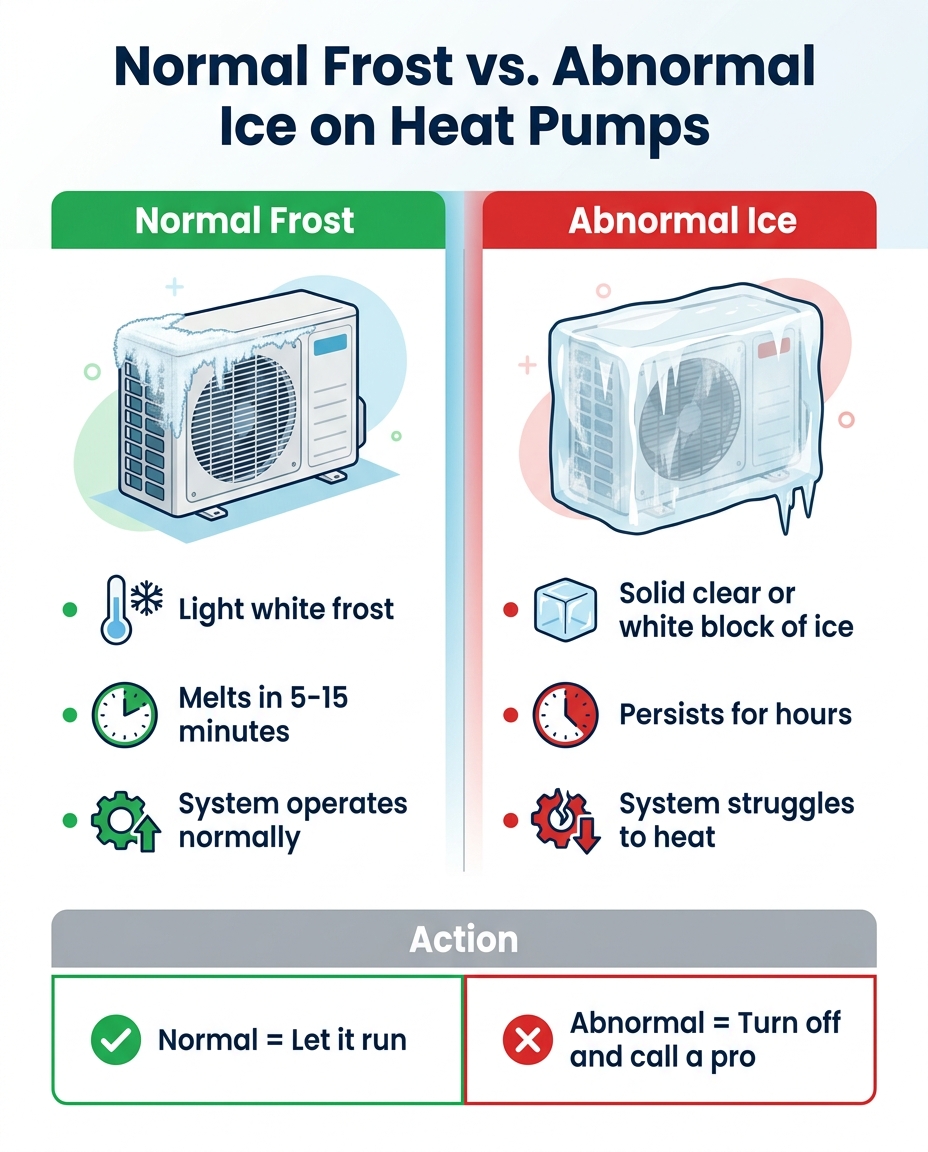
Normal Frost vs. Abnormal Ice: Visual Indicators
While a quick defrost cycle is nothing to worry about, a system that becomes completely encased in ice is a serious problem. In our years of providing HVAC services across the Mammoth Lakes high-altitude climate, we have found that knowing the visual difference between a normal operational state and a malfunction is vital for homeowners. Our team typically sees a spike in panic calls every September simply because folks do not know what to look for when inspecting their outdoor unit.
Normal frost appears as a light, even coating of white crystals. It looks very similar to the frost you might scrape off your car windshield in the morning. Most importantly, this frost will disappear completely within 15 minutes once the defrost cycle kicks in. Abnormal ice, on the other hand, looks like a thick, solid block of clear or dense white ice that encases the coils, the fan blades, and sometimes the entire outer cabinet of the unit. If you see ice persisting for hours, creeping up the copper refrigerant lines, or hear the fan blades grinding against a block of ice, you are looking at a serious malfunction.
• Appearance of the Ice — Normal Fall Frost: Light, fuzzy white coating, similar to a frosted windshield. — Abnormal Ice Buildup: Thick, solid, clear or dense white blocks encasing the unit.
• Duration of the Buildup — Normal Fall Frost: Melts away entirely within 5 to 15 minutes. — Abnormal Ice Buildup: Persists for hours or even days without melting.
• Location of the Frost — Normal Fall Frost: Evenly distributed across the delicate metal fins. — Abnormal Ice Buildup: Creeping up the copper refrigerant lines or into the fan grate.
• System Sounds — Normal Fall Frost: Normal hum, a loud whoosh when shifting modes, fan stops briefly. — Abnormal Ice Buildup: Loud grinding, buzzing, or the sound of fan blades hitting solid ice.
• Heating Performance — Normal Fall Frost: Home remains warm and comfortable. — Abnormal Ice Buildup: System struggles to heat the home, blowing lukewarm or cold air.
Normal Frost vs. Abnormal Ice on Heat Pumps
When Ice Indicates a Refrigerant Leak or Restricted Airflow
If your visual inspection reveals a solid block of ice rather than a light September early fall frost, your system is crying out for help. One of the most common and severe causes of abnormal icing is a low refrigerant charge. Refrigerant is the lifeblood of your heat pump; it absorbs and releases heat to keep your home comfortable. When the system is low on refrigerant, the pressure inside the copper lines drops significantly. This pressure drop causes the temperature of the outdoor coil to plummet well below its normal operating range, freezing any ambient moisture so rapidly that the defrost cycle simply cannot keep up.
Another frequent culprit is restricted airflow. For the defrost cycle to work, the system needs to be able to move air efficiently. If your indoor air filters are heavily clogged with dust and pet hair, or if your outdoor unit is choked by fallen autumn leaves and debris, the heat exchange process breaks down. Furthermore, the issue might lie in the system's brain: a faulty defrost sensor or a failing control board might simply forget to tell the system to melt the ice, allowing it to build up endlessly.
If you suspect any of these issues, you can consult a comprehensive HVAC troubleshooting guide to understand the symptoms better. However, it is absolutely vital to know your limits. Checking or adding refrigerant requires specialized gauges, high-pressure equipment, and Environmental Protection Agency (EPA) certification. Never attempt to check or recharge refrigerant levels yourself; this work strictly requires a licensed professional.
The Danger of Low Refrigerant
Refrigerant is a closed loop: Your heat pump does not "consume" refrigerant like a car consumes gas. If the levels are low, it means there is a physical leak in the copper lines or coils that must be located and repaired.
Ice forms rapidly when pressure drops: The physics of the system dictate that lower pressure equals lower temperatures. A leak forces the coil temperatures so low that ice forms faster than it can ever be melted.
Running the system destroys the compressor: The compressor is the most expensive part of your heat pump. Forcing it to run with low refrigerant and a block of ice insulating the coils will cause it to overheat and eventually fail entirely, leading to massive repair bills.
What to Do When Your System Freezes Solid
Discovering a solid block of ice on your outdoor unit can be alarming, especially when the Mammoth Lakes high-altitude climate is already driving temperatures down. If you have confirmed that the ice is abnormal and persisting for hours, you need to take immediate action to protect your equipment from permanent damage. Following the right steps can mean the difference between a simple sensor replacement and a completely destroyed compressor.
1. Turn off the heat pump immediately: Go to your indoor thermostat and switch the primary heating system to the "Off" position. Allowing the system to continue running while encased in ice will severely strain the compressor and blower motor.
2. Switch to emergency heat: If your home is getting too cold, look for the "Emergency Heat" or "Auxiliary Heat" setting on your thermostat. This bypasses the frozen outdoor heat pump and relies entirely on your indoor electric heat strips to keep your family warm while you wait for a repair.
3. Never use sharp objects or hot water: It is incredibly tempting to grab an ice pick, a screwdriver, or a bucket of hot water to clear the ice away. Never do this. Sharp objects will easily puncture the delicate, pressurized refrigerant coils. Hot water can cause severe thermal shock, cracking the metal and destroying the unit instantly.
4. Contact a local professional: Once the system is safely turned off, reach out for expert HVAC services in Mammoth Lakes. A licensed technician can safely diagnose the root cause, whether it is a faulty sensor, a clogged filter, or a refrigerant leak.
Frequently Asked Questions About Heat Pump Icing
Is it normal for a heat pump to have ice on it in the fall?
Yes, a light coating of frost is completely normal during early fall cold snaps, especially in higher elevations. When the outdoor temperature drops and ambient moisture hits the cold metal coils, frost naturally forms. However, the system's automated defrost cycle should easily melt this light frost off within about 15 minutes.
How long does a heat pump defrost cycle take?
A standard defrost cycle typically lasts between 5 and 15 minutes, depending on how much September early fall frost has accumulated. The cycle automatically ends when the internal sensors detect that the outdoor coil temperature has reached roughly 57 degrees Fahrenheit, signaling that all ice has melted.
Does low refrigerant cause a heat pump to freeze?
Yes, low refrigerant is one of the leading causes of abnormal freezing. A leak in the system causes a severe pressure drop, which drastically lowers the temperature of the outdoor coil. This results in a thick, solid block of ice that the standard defrost cycle is simply not powerful enough to clear away.
What should I do if my heat pump is stuck in defrost mode?
If your system seems to be constantly blowing cold air and never returning to normal heating mode, turn the system off at the thermostat to prevent further damage. Being stuck in defrost mode usually indicates a failed temperature sensor or a malfunctioning control board. You will need to call a licensed technician to test and replace these electronic components.
Can I scrape the ice off my heat pump?
No, you should never use tools, scrapers, or sharp objects to remove ice from your outdoor unit. The aluminum fins and copper refrigerant coils are incredibly delicate. Scraping the ice risks puncturing these lines, which will instantly release all your refrigerant and lead to incredibly expensive repairs.
Why does elevation affect my heat pump's frost buildup?
Higher elevations experience much faster and more dramatic ambient temperature drops as soon as the sun goes down. Because the thin mountain air cannot hold heat, the rapid cooling increases the frequency of necessary defrost cycles. Your system will simply have to work harder to manage frost in the mountains than it would at sea level.
Preventing Unexpected Freeze-Ups Before Winter
The best way to handle a frozen heat pump is to prevent it from happening in the first place. Early fall is the absolute ideal time to schedule a pre-heating season tune-up. By having a professional inspect your system in September, you can catch the small, hidden issues that lead to massive freeze-ups in January. Routine checks allow technicians to spot slow refrigerant leaks, test failing defrost sensors, and verify that your control boards are communicating properly before the harsh winter weather arrives.
For example, our team at MCR Services Inc. recently helped a local homeowner who reached out when they realized they needed reliable boilers, heat pumps, and overall HVAC services to prepare for the changing seasons. After our technicians provided prompt, excellent work, they found their home completely prepared for the harsh weather ahead. Maintaining your system is about creating that exact kind of reliability for your own family.
Beyond professional inspections, you play a vital role in keeping your system ice-free. Changing your indoor air filters regularly is the single most important thing you can do to maintain the proper airflow required for a healthy defrost cycle. If your system is older and constantly struggling with the Mammoth Lakes high-altitude climate, it might be time to consider an upgrade. Keep in mind that generic energy rebates, utility incentives, or federal tax credits may apply to qualifying high-efficiency heat pump installations, making a reliable upgrade more accessible. We always advise checking with your local utility provider to see what general programs are currently active.
To keep your system running flawlessly, consider enrolling in a routine maintenance plan to stay ahead of the weather.
Schedule Your Pre-Season Heat Pump Inspection Today
Understanding why your heat pump might ice up during early fall frosts empowers you to make smart decisions about your home comfort. While a light dusting of September early fall frost is just a normal part of the seasonal transition, a persistent, solid block of ice is a clear cry for help. Do not wait until you are shivering in deep winter to find out that a slow refrigerant leak has finally taken down your compressor.
If you have noticed abnormal ice buildup, strange grinding noises, or a system that just cannot seem to keep your house warm, it is time to bring in an expert eye. Taking proactive steps now ensures that your equipment will run efficiently and safely all season long. Contact our local team today to schedule a comprehensive diagnostic or your annual pre-season maintenance visit, and enjoy the peace of mind that comes with a perfectly tuned heating system.
Sed iaculis aenean sit sed risus arcu vitae integer elit.
5 min read
Why Your Heat Pump Might Ice Up During Early Fall Frosts
Finding frost on your outdoor unit in September often triggers panic about a major breakdown. Discover the difference between a normal seasonal defrost cycle and a true refrigerant leak.
The Mechanics of Carbon Monoxide Detection in Tightly Sealed Winter Cabins
Weatherproofing your cabin for winter traps heat, but it also traps dangerous combustion gases from aging furnaces. See why low-level monitors are essential for safety.
Winterizing Mobile Home HVAC Systems Against Bishop's Freezing Nights
Standard residential heating checklists ignore the exposed underbellies of manufactured housing. Protect your mobile home's ductwork before the first hard freeze hits the Eastern Sierra.