5 min read
Why Your Boiler Pilot Light Keeps Going Out in Cold Drafts
Waking up to a freezing house because your boiler pilot light blew out is a frustrating October surprise. Find out if it's a simple draft issue or a failing thermocouple.



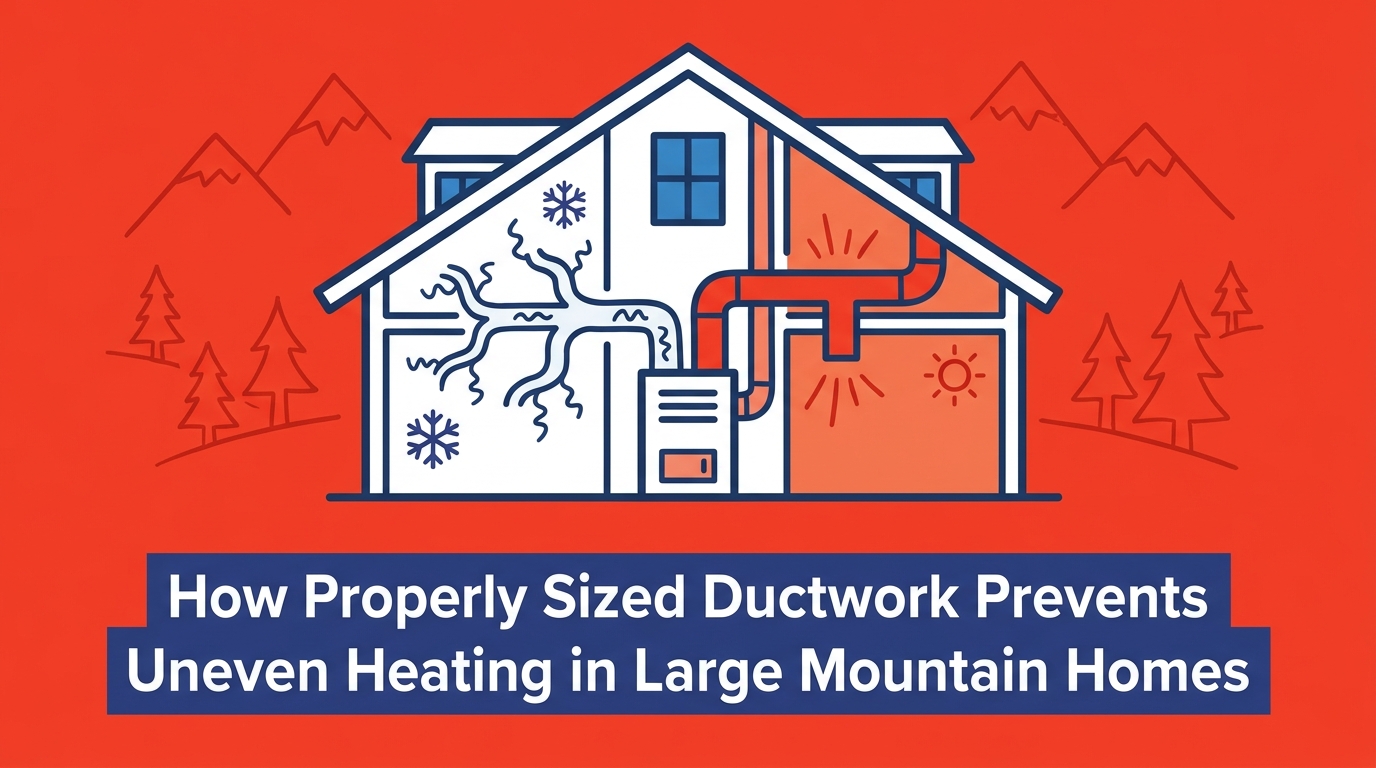
The September pre-heating season is closing in fast, and understanding how properly sized ductwork prevents uneven heating in large mountain homes is the first step to a comfortable winter. Before the first major freeze hits, many homeowners begin testing their heating setups, only to rediscover a familiar and frustrating problem. At MCR Services Inc., we see this pattern every early fall: you turn up the thermostat to warm up the house, but while the main floor quickly becomes uncomfortably hot, the upper-level bedrooms remain freezing cold. It is a common scenario that leaves families bundling up indoors, even when the heating equipment is running constantly.
When faced with this extreme temperature imbalance, our customers' immediate assumption is often that the current furnace is simply too small or too old to handle the square footage. However, the real culprit is usually hidden behind your walls. In most cases, our technicians find that the core issue is restricted airflow caused by undersized ducts, rather than a lack of heating capacity. If you want to permanently resolve these stubborn cold spots, evaluating your heating systems and the network of pipes that deliver the air is essential before the harsh winter weather arrives.
The Problem: When rooms feel cold, the natural homeowner instinct is to buy a bigger, more powerful furnace. It seems logical—if the heat is not reaching the upstairs bedrooms in Mammoth Lakes large mountain homes, a larger blower motor and a higher heating capacity should force the warm air where it needs to go. Over the years, we have seen many homeowners invest heavily in a top-tier, high-capacity unit, expecting their comfort issues to disappear instantly.
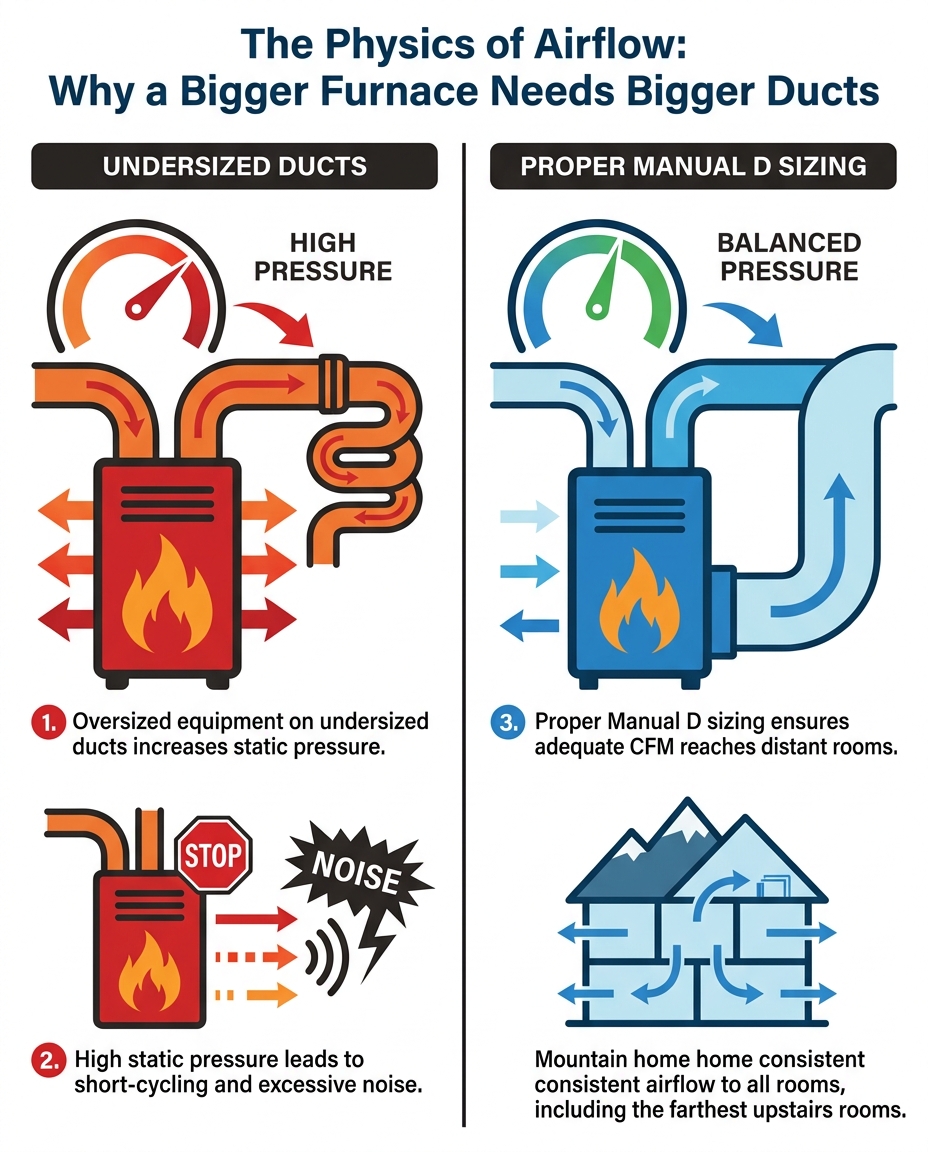
The Cause: Unfortunately, throwing a larger furnace at a house with undersized ducts will not solve the problem. Think of your ductwork like a garden hose and your new, oversized furnace like a high-pressure fire hydrant. If you try to force a massive volume of water through a narrow garden hose, the hose cannot expand to accommodate the flow. The pressure builds up, the water backs up, and the system strains under the immense resistance. The same physics apply to your HVAC airflow. A larger blower motor cannot overcome the physical limitations of small ductwork; it only pushes harder against a barrier that will not yield.
The Solution: Instead of rushing to replace the primary heating unit, our team recommends shifting the focus to the delivery system. Connecting an oversized furnace to undersized ducts leads to severe negative consequences, including short-cycling, excessive wind noise, and premature wear on the equipment. When the system forces too much air into a tight space, the furnace overheats and shuts down repeatedly to protect itself. To achieve true comfort, you need professional HVAC services to evaluate the existing ductwork and ensure it is properly matched to the volume of air your home requires.
To truly grasp how properly sized ductwork prevents uneven heating in large mountain homes, you have to understand the physics of static pressure. In residential HVAC systems, static pressure is essentially the resistance to airflow within your ductwork. A certain amount of resistance is normal and necessary for the system to function, but when ducts are too small, twisted, or poorly designed, that resistance spikes. High static pressure means your blower motor has to work much harder to push the conditioned air through the supply vents. When we run diagnostics on mountain homes, high static pressure is one of the most frequent culprits we uncover.
When resistance is too high, the system cannot deliver the required Cubic Feet per Minute (CFM) of warm air to distant rooms. The air loses its velocity and heat energy before it ever reaches the end of the duct run. Furthermore, this restricted airflow causes the furnace heat exchanger to overheat. When the heat cannot escape into the home quickly enough, the internal temperature of the furnace rises dangerously high, triggering built-in safety mechanisms that shut the system down completely.
Supply ducts push warm air into your rooms, but return ducts pull the cold air back into the furnace to be heated. A furnace can only push out as much air as it pulls in. In our experience evaluating local HVAC configurations, if your home has undersized return grilles or a lack of return ducting, the system is effectively suffocating. It is like trying to breathe while running a marathon with a straw in your mouth. Expanding the return side of your system is often one of the most effective ways we lower high static pressure and restore balanced heating to the entire house.

Living in a high-altitude environment introduces a unique set of variables that drastically alter heating dynamics. In regions like ours with freezing, snowy winters, the air is thinner and less dense. Because high-altitude air has less mass, your heating system's blower motor actually has to work harder and move a larger volume of air to transfer the same amount of heat into your living spaces. This means that precise volume calculations are absolutely critical for Mammoth Lakes large mountain homes; a duct system that might work perfectly at sea level will struggle significantly at elevation.
Beyond the air density, the architectural features of multi-story mountain cabins present significant hurdles we navigate daily. Vaulted ceilings, massive A-frame windows, and sprawling layouts require long, complex duct runs to reach upper floors. Heat naturally rises, but without proper airflow management, it simply pools at the ceiling of the main level, leaving the actual living spaces cold. When extreme freezing temperatures hit, these minor airflow imbalances become highly noticeable, causing drastic temperature swings from room to room.
Addressing these architectural and environmental factors requires specialized knowledge. Working with heating experts in Mammoth Lakes like MCR Services Inc. means partnering with professionals who understand high-altitude HVAC dynamics and can engineer customized airflow solutions for complex, multi-story layouts.
Before you call our team for professional diagnostics, there are several self-diagnostic clues you can look for during the early fall months. Recognizing the symptoms of high static pressure early can save you from a mid-winter breakdown.
• Excessive wind noise or whistling: If your vents sound like a jet engine taking off or emit a high-pitched whistle when the heat kicks on, your system is trying to force too much air through an opening that is too small.
• Frequent furnace cycling: If your furnace turns on, runs for three minutes, shuts off, and then turns back on again shortly after, it is likely short-cycling. This is a protective response to overheating caused by trapped air.
• Drastic temperature variations: Pay attention to the rooms at the end of your duct runs. If the room closest to the furnace is sweltering while the furthest room is freezing, the airflow is failing to reach the end of the line.
• Doors closing on their own: If interior doors slam shut or are difficult to open when the system is running, you have a severe pressure imbalance between the supply and return air in those rooms.
• Hot furnace exterior: If the physical metal cabinet of your furnace is uncomfortably hot to the touch while running, the heat exchanger is not shedding its heat into the ductwork effectively.
A crucial warning: Never attempt DIY duct modifications to solve these issues. Cutting into sheet metal, taping over vents, or removing dampers without a thorough understanding of airflow dynamics will often make the pressure imbalance worse. High static pressure requires professional testing and measurement to correct safely.
Proper duct sizing is a strict mathematical science, not a guessing game. The industry standard for residential duct design is known as ACCA Manual D, and it is the exact protocol our team follows. When we design a system using Manual D, we calculate the exact friction loss of every elbow, transition, and length of pipe in the house.
We evaluate the required CFM for each specific room based on its size, window placement, and insulation levels. This scientific approach is a sharp contrast to the outdated "rule of thumb" sizing that plagues many older homes, where contractors simply guessed at duct sizes based on the square footage of the house.
• Rule of Thumb (Outdated) — Methodology: Guessing duct sizes based solely on home square footage. — Impact on Static Pressure: Often leads to high static pressure, suffocated equipment, and noisy vents.
• Manual D (Scientific) — Methodology: Calculating friction loss, CFM requirements, and exact pipe lengths. — Impact on Static Pressure: Maintains balanced static pressure, ensuring quiet and even heat distribution.
Relying on proper Manual D design guarantees that the furnace operates at its peak efficiency and intended lifespan. It eliminates the guesswork and proves that resolving high static pressure requires precise engineering, ensuring that every room receives the exact volume of warm air it needs.
The Problem: Sometimes, entirely replacing undersized ductwork hidden behind finished walls and vaulted ceilings is simply not feasible. Homeowners in Mammoth Lakes large mountain homes often face the reality that their structural layout makes traditional duct expansion incredibly invasive and disruptive.
The Cause: The existing architecture may physically block the installation of larger trunk lines, or the distance from the central furnace to an isolated addition is just too great for the blower motor to overcome, regardless of how well the ducts are sealed.
The Solution: Fortunately, there are actionable alternatives. Our professional duct modifications, such as enlarging the main trunk lines near the furnace or adding strategic return drops, can relieve a significant amount of pressure without tearing open every wall. When central ductwork limitations cannot be bypassed, targeted zoned heating becomes the ideal answer. Ductless mini-splits are highly effective for isolated cold rooms, additions, or upper-level bedrooms. By delivering heat directly to the space without relying on the central duct network, you eliminate the static pressure problem entirely.
Even outside of large multi-story builds, targeted solutions prove their worth. For instance, our team recently helped a local customer in a mobile home who struggled with extreme temperatures during the hot summer. After removing an ineffective swamp cooler, we installed two mini-split units. The outcome was immediate—the space became dramatically more comfortable, proving that localized systems offer incredible control. Understanding the balance between central heating vs. zoned mini-splits for uneven heat allows us to customize your comfort, ensuring that every corner of the house remains cozy without overworking your primary furnace.
True indoor comfort comes from balanced airflow, not just a bigger furnace. If your home struggles with extreme temperature differences between floors, upgrading your heating equipment without addressing the delivery system will only lead to frustration, premature breakdowns, and wasted energy. The physics of airflow demand that the ductwork matches the capacity of the blower motor perfectly.
Take advantage of the September pre-heating season to schedule a professional static pressure and airflow evaluation with our experts. By diagnosing the root cause of your cold spots now, you can implement targeted modifications or zoned solutions before the extreme cold sets in, ensuring your home remains consistently warm all winter long.
Why is one room in my multi-story house always so cold?
A single cold room is usually the result of restricted airflow or a duct run that is too long. When warm air travels a great distance through undersized ducts, it loses velocity and heat energy before it reaches the vent. Having a professional measure the airflow to that specific room can determine if a duct modification or a supplemental heat source is needed.
Can you put a bigger furnace on existing, older ductwork?
Installing a larger furnace on older, existing ductwork is generally a bad idea unless the ducts are evaluated first. If the older ducts are too small for the increased air volume, the new furnace will suffer from high static pressure. This leads to overheating, short-cycling, and a significantly shortened lifespan for your new equipment.
What happens if HVAC return ducts are too small?
If return ducts are too small, the furnace cannot pull in enough air to operate efficiently. This suffocates the system, causing the blower motor to strain and the heat exchanger to overheat. Expanding the return air capacity is often the fastest way our technicians improve overall system performance and balance temperatures.
Does duct size really affect heating efficiency?
Yes, duct size directly impacts heating efficiency. Undersized ducts force the system to work harder to distribute air, increasing energy consumption while failing to heat the home evenly. Properly sized ducts allow the furnace to run in its ideal operating range, maximizing both comfort and energy efficiency.
How do professionals measure HVAC static pressure?
Our technicians measure static pressure using a specialized tool called a manometer. We insert small probes into the ductwork on both the supply and return sides of the furnace to read the resistance in the system. These readings tell us exactly how hard the blower motor is working and where the airflow bottlenecks are located.
Can ductless systems fix uneven heating in a mountain cabin?
Ductless systems are an excellent solution for uneven heating in mountain cabins. Because they do not rely on central ductwork, they completely bypass the airflow limitations that cause cold upper floors. Installing a ductless unit in a stubborn cold spot provides precise, independent temperature control exactly where you need it.