5 min read
Why Your Boiler Pilot Light Keeps Going Out in Cold Drafts
Waking up to a freezing house because your boiler pilot light blew out is a frustrating October surprise. Find out if it's a simple draft issue or a failing thermocouple.



The September pre-heating season is officially here, but turning on your heating system for the first time shouldn't sound like a fireworks show. If you find yourself asking, "Why is my furnace making a banging noise on startup?", you are dealing with a specific mechanical issue that requires immediate attention. Many homeowners mistake this loud, startling sound for the normal waking noises of ductwork expanding after a long summer off. However, a heavy boom or bang originating from the cabinet is a massive red flag indicating a dangerous mechanical failure.
To protect your HVAC system, scheduling professional heating repair is the smartest first step. The noise you hear is tied to a specific safety hazard known as delayed ignition. This happens when there is excess gas accumulation in the combustion chamber before the igniter finally catches. Addressing this symptom early in the season prevents catastrophic failure, structural damage to your equipment, and potential safety risks when winter temperatures eventually drop.
Delayed ignition is a mechanical failure where the burners inside your heating unit fail to light immediately upon receiving gas. To understand why this happens, it helps to look at the sequence of events that should occur when your thermostat calls for heat, versus what happens when the system is malfunctioning.
Here is the mechanical sequence of how delayed ignition creates that startling noise:
1. The gas valve opens: When the thermostat signals the system to turn on, the gas valve releases fuel into the burners.
2. The igniter attempts to spark: In a healthy system, the electronic igniter or pilot light immediately ignites this gas, creating a smooth, quiet flame.
3. The delay occurs: If the igniter is dirty, misaligned, or failing, it struggles to create a spark. During this delay, the gas valve remains open, continuously pumping fuel into the chamber.
4. Fuel pooling: Because the gas is not burning off, you end up with excess gas accumulation in the combustion chamber.
5. The sudden ignition: When the igniter finally manages to spark, it ignites a much larger volume of gas all at once.
6. The shockwave: The sudden combustion of this pooled fuel creates a rapid expansion of gases—essentially a small explosion—which forces a physical shockwave against the metal walls of the cabinet.
This sequence places immense strain on your equipment. Catching this mechanical delay early by scheduling your furnace startup before the first snowfall is critical. The longer the delay lasts, the more gas pools, and the louder and more damaging the resulting bang becomes.
The Problem: A healthy system lights gas seamlessly, creating a smooth, quiet whoosh of flames that you barely hear through the floorboards. When that process is disrupted, the gas-to-air ratio becomes highly volatile. The loud boom you hear is literally a small explosion safely contained—for now—within the metal housing of the unit.
The Cause: The physics of this mini-explosion come down to volume and pressure. The combustion chamber is designed to handle a steady, controlled burn of gas. When excess gas accumulation in the combustion chamber occurs, the sudden ignition creates a pressure spike that the metal housing was never engineered to withstand. Repeated mini-explosions put immense structural stress on the entire heating unit, violently shaking internal components, loosening fittings, and threatening the integrity of the safety barriers.
The Solution: Because this involves highly combustible natural gas or propane, it requires a licensed professional to diagnose and correct the fuel-to-air mixture and ignition timing. Attempting to clean or adjust these components without proper training can easily result in gas leaks or worse.
Several underlying mechanical failures can prevent the burners from lighting on time. A professional technician will typically look for the following issues:
• Corrosion or carbon buildup: Over time, rust, soot, and carbon can clog the tiny ports on the burners. This prevents the gas from flowing evenly across the burner assembly, causing it to pool in one area until it reaches the igniter.
• Misaligned or failing electronic igniters: Modern systems use hot surface igniters or spark igniters. If these components are physically misaligned, cracked, or losing electrical resistance, they will not generate enough heat to light the gas instantly.
• Inadequate gas supply pressure: If the gas pressure coming into the unit is too low or too high, it alters the delicate mixture of oxygen and fuel, making it difficult for the spark to catch immediately.
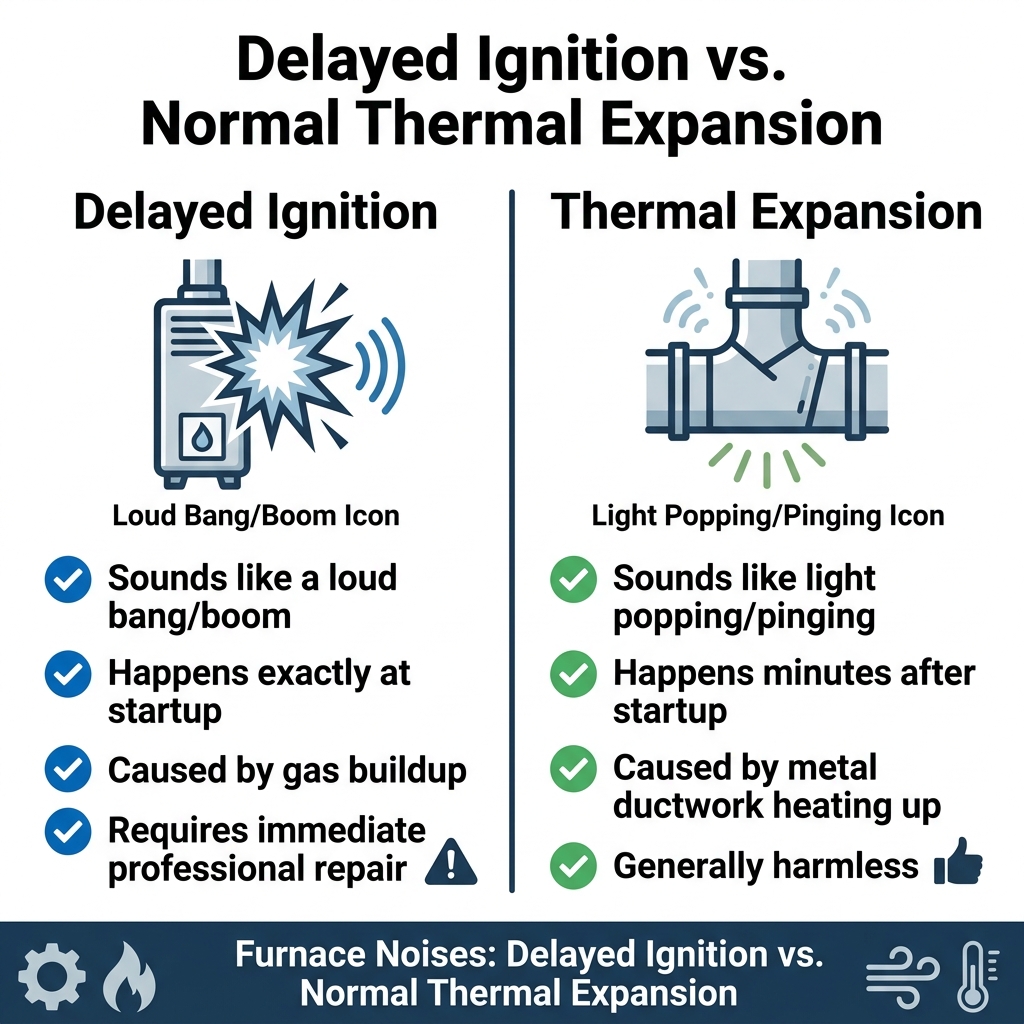
It is common for heating systems to make some noise, especially during the September pre-heating season when they fire up for the first time in months. The key to keeping your home safe is knowing how to differentiate between the normal thermal expansion of ductwork and the dangerous combustion sounds of delayed ignition.
Ductwork naturally expands and contracts as hot air hits cold sheet metal. This causes light popping, pinging, or ticking sounds. Conversely, a delayed ignition bang happens at the exact moment the burners attempt to light, often physically shaking the unit. If the sound resembles a heavy thud or a shotgun blast originating directly from the cabinet, it is a combustion issue.
• Sound Type — Thermal Expansion (Normal): Light popping, pinging, ticking, or creaking. — Delayed Ignition (Dangerous): Loud boom, heavy bang, or shotgun-like blast.
• Timing of Noise — Thermal Expansion (Normal): Occurs a few minutes after the blower motor starts running and warm air begins flowing. — Delayed Ignition (Dangerous): Occurs at the exact moment the system attempts to ignite the burners, before the blower starts.
• Location — Thermal Expansion (Normal): Originates from the vents, walls, ceilings, or exposed ductwork in the basement. — Delayed Ignition (Dangerous): Originates directly from inside the main metal cabinet of the heating unit.
• Cause — Thermal Expansion (Normal): Cold sheet metal expanding rapidly as hot air passes through it. — Delayed Ignition (Dangerous): Excess gas accumulation in the combustion chamber igniting all at once.
• Action Required — Thermal Expansion (Normal): None. This is a normal physical reaction to temperature changes. — Delayed Ignition (Dangerous): Immediate professional repair. Shut the system off at the thermostat.

For homeowners in mountainous regions, the local climate and elevation play a massive role in how heating equipment operates. Gas appliances require a highly specific mixture of oxygen and fuel to burn cleanly and safely. At higher elevations, the thinner air fundamentally alters this critical combustion ratio.
Mammoth Lakes sits at roughly 7,800 feet above sea level. At this altitude, the air is significantly less dense, meaning there is less oxygen available per cubic foot of air drawn into the combustion chamber. If a heating system is installed straight out of the box without high-altitude modifications, the standard factory settings will pump in too much gas for the available oxygen. This creates a "rich" fuel mixture.
Furnaces operating at altitude must be professionally calibrated to prevent fuel pooling. This process, known as derating, involves changing the burner orifices to reduce the volume of gas entering the chamber, ensuring it matches the thinner air supply. Without proper high-altitude adjustments, the risk of excess gas accumulation in the combustion chamber increases significantly, making delayed ignition a much more common threat. When seeking heating services in Mammoth Lakes, it is vital to work with technicians who understand the specific physics of high-altitude combustion.
Ignoring a loud bang on startup is one of the most dangerous mistakes a homeowner can make. The noise itself is just a symptom; the real threat is the physical damage occurring inside the cabinet every time that mini-explosion goes off.
The primary risks of untreated delayed ignition include:
• Cracked Heat Exchangers: The heat exchanger is a vital metal shield that separates the toxic combustion gases from the clean air being blown into your home. The repeated shockwaves from continuous delayed ignition stress the metal, eventually causing hairline cracks.
• Carbon Monoxide Leaks: Once the heat exchanger cracks, deadly, odorless carbon monoxide can leak out of the combustion chamber and be distributed through your ductwork into your living spaces.
• Total System Failure: The violent shaking can damage the gas valve, misalign the burners further, and destroy the igniter. Ignoring the issue can lead to complete system failure during the coldest months of the year when you need heat the most.
• Fire Hazards: In extreme cases, flames can roll out of the front of the unit when the excess gas ignites, potentially catching nearby dust, debris, or wiring on fire.
Routine maintenance and prompt, knowledgeable repairs are the only safe ways to resolve combustion issues. This is where expert, safety-focused diagnostics make all the difference. A professional won't just scrub the burners and leave; they will perform a comprehensive safety check to look for hidden structural damage, ensuring the heat exchanger hasn't already been compromised by the shockwaves.
One recent customer reached out for general HVAC system repairs after noticing unusual behavior from their equipment. By providing prompt service, reasonable pricing, and a thorough safety inspection, the technician was able to resolve the underlying mechanical faults before they escalated into a complete breakdown. The customer was highly satisfied, knowing their system was safe and fully functional for the season ahead. Keeping up with a routine heating maintenance schedule is the best way to catch these exact types of hidden dangers before they turn into emergencies.
No. A banging noise indicates a serious combustion issue known as delayed ignition. Continuing to run it risks cracking the heat exchanger and causing carbon monoxide leaks. Every time the system bangs, it forces a shockwave against the internal metal components. You should turn the system off immediately and call a licensed professional to diagnose the fuel mixture and ignition timing.
While a catastrophic, house-level explosion is rare due to built-in safety features, the mini-explosions inside the cabinet are highly destructive. These internal blasts severely damage the equipment and compromise home safety. Excess gas accumulation in the combustion chamber creates enough force to blow the front door off the cabinet, crack the heat exchanger, and cause flame rollout, which is a serious fire hazard.
Fixing delayed ignition requires a licensed professional to clean the burners, check gas pressure, and align the igniter. Because it involves highly combustible gas, it is never a safe DIY project. A technician will use specialized tools to measure the gas manifold pressure, inspect the micro-ports on the burner assembly for carbon buildup, and ensure the hot surface igniter is drawing the correct electrical current.
A shotgun-like noise is the sound of excessive gas igniting all at once. This happens when the ignition sequence is delayed, allowing fuel to flood the chamber before the spark catches. Instead of a small, controlled flame lighting instantly, a large volume of gas combusts simultaneously, creating a rapid expansion of air and a loud boom that echoes through your ductwork.
Yes, a comprehensive professional tune-up addresses the root causes, such as dirty burners or misaligned igniters. It also includes safety checks to ensure the banging hasn't already damaged the heat exchanger. During a tune-up, the technician cleans the combustion chamber, calibrates the gas pressure, and verifies that the ignition sequence is functioning smoothly, effectively eliminating the conditions that cause delayed ignition.
A loud bang on startup is not a quirk of an aging system; it is a clear warning sign of delayed ignition. The longer you allow excess gas to pool and explode inside your cabinet, the higher your risk becomes for cracked heat exchangers, carbon monoxide exposure, and complete equipment failure.
If you are still wondering, "Why is my furnace making a banging noise on startup?", the safest action you can take is to shut off the system at the thermostat immediately. Do not wait for the noise to go away on its own. Contact a licensed professional for expert diagnostics and safe resolution to ensure your home remains warm and secure throughout the September pre-heating season and into the deep winter freeze.