5 min read
Why Your Boiler Pilot Light Keeps Going Out in Cold Drafts
Waking up to a freezing house because your boiler pilot light blew out is a frustrating October surprise. Find out if it's a simple draft issue or a failing thermocouple.



You step outside on a blustery afternoon, and over the roar of the wind, you hear your outdoor unit struggling to start up—a clear reminder that The Unique Challenges of HVAC Servicing in High-Wind Areas Like Chalfant require specialized solutions. The Eastern Sierra region is notorious for intense, sustained gusts, particularly during the September pre-heating season transition. Just as homeowners begin testing their furnaces while still relying on late-season cooling, these powerful crosswinds put immense mechanical stress on outdoor units and gas heating components. If you live in this specific microclimate, you face a distinct decision point: accept a standard, out-of-the-box equipment setup that remains highly vulnerable to aerodynamic stress, or invest in specific wind-baffling and motor-protection adjustments designed for the realities of local weather.
If you want to ensure your HVAC systems survive this turbulent transition period without unexpected breakdowns, you need an approach tailored entirely to your environment.
Most standard climate control installations are designed for relatively calm, predictable weather patterns. Manufacturers build equipment to withstand rain, snow, and standard temperature fluctuations. However, chronic aerodynamic stress is an entirely different beast. The constant battering of high-velocity air does more than just rattle the metal casing of your outdoor condenser. It exerts a persistent, invisible load on moving parts, exhaust flues, and sensitive internal mechanisms.
When the wind howls down the valley, it turns your property into a wind tunnel. This creates a relentless physical resistance that your equipment was never engineered to fight on its own. Recognizing this hidden toll is the first step toward protecting your investment. By understanding exactly how the local climate interacts with your machinery, you can make informed decisions about structural upgrades that will keep your home comfortable, regardless of what the weather is doing outside.
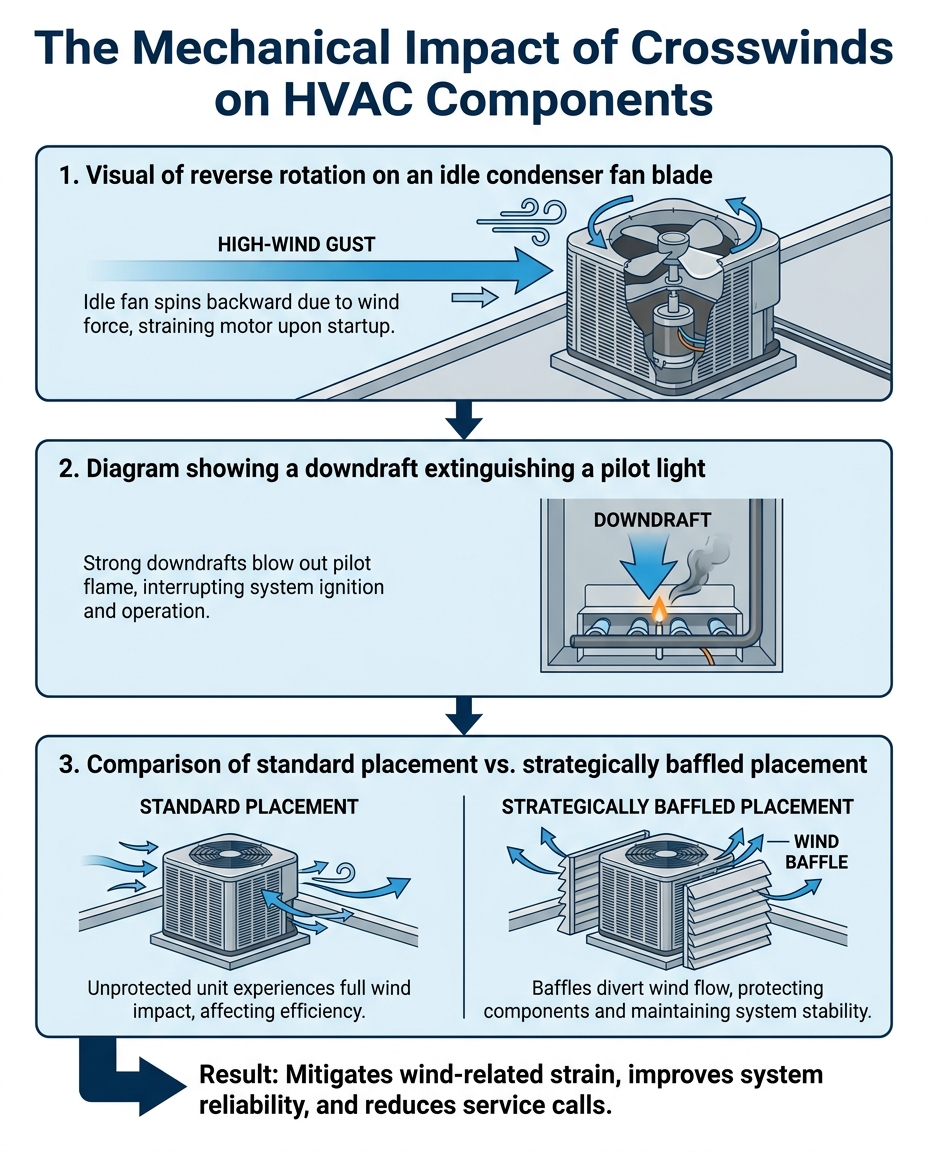
To understand why systems fail in this region, we have to look closely at the physics of airflow and mechanical resistance. The most common victim of severe crosswinds is the outdoor unit's fan motor. When your air conditioner or heat pump cycles off, the large fan blades at the top of the unit sit idle. If a strong gust of wind hits the unit at the right angle, it catches those idle blades and causes them to spin backward—a phenomenon known as reverse rotation.
The Hidden Cost of Torque Stress
The real damage occurs the moment your thermostat calls for cooling or heating. The system sends an electrical signal to start the fan motor. However, instead of starting from a standstill, the motor must forcefully brake the reverse-spinning blades and immediately accelerate them in the correct direction. This creates a massive spike in electrical draw and severe torque stress on the motor shaft and internal windings.
Starting against this wind-driven momentum is like trying to put your car in drive while rolling backward down a hill. The mechanical strain is enormous. Over time, this chronic daily crosswind wear degrades the internal components of outdoor unit fan motors and pilot light assemblies. Homeowners often notice the early warning signs: the unit hums loudly but fails to start, or the circuit breaker trips frequently during windy afternoons. Eventually, the extreme torque stress leads to complete, premature motor burnout.
Chronic Wear vs. Storm Damage
It is important to distinguish between one-off storm damage and chronic aerodynamic wear. A severe storm might blow a tree branch into your condenser, causing immediate, visible destruction. Chronic crosswinds, however, are a daily grind. The wear and tear happens invisibly over months and years. Because the damage is cumulative, many homeowners are caught off guard when a relatively new fan motor simply stops working.
If you find yourself frequently needing AC repair in Chalfant, reverse rotation and wind-induced torque stress are highly likely culprits. Standard maintenance alone cannot prevent this specific type of mechanical sabotage; it requires a physical intervention to change how the wind interacts with the unit.

As the late-summer heat fades and the September pre-heating season transition begins, homeowners shift their focus from cooling to warmth. Unfortunately, the exact same crosswinds that sabotage outdoor fan motors also wreak havoc on older gas heating equipment. The core issue here is atmospheric drafting—the way air moves into and out of your home's venting system.
Understanding Atmospheric Drafting
Gas furnaces and water heaters rely on a delicate balance of air pressure to exhaust combustion gases safely out of your home. When strong crosswinds rush over your roofline, they create severe pressure differentials. In some cases, the wind creates a high-pressure zone right at the opening of your exhaust flue. This forces air rapidly down the pipe, creating a strong downdraft.
For older heating equipment that relies on a standing flame, this downdraft acts exactly like a person blowing out a candle. The rush of air frequently extinguishes standing pilot lights. If you regularly find yourself trekking into the garage or basement to relight your furnace on blustery autumn evenings, atmospheric drafting is the root cause.
The Safety and Reliability Impact
Modern heating equipment is equipped with safety mechanisms, such as thermocouples, that automatically shut off the gas supply when the flame goes out. While this prevents dangerous gas leaks, it creates a massive reliability problem. Losing your primary heat source during a cold, windy night is more than just an inconvenience; it can lead to dangerously low indoor temperatures and frozen pipes if left unchecked.
The vulnerability of outdoor unit fan motors and pilot light assemblies highlights a broader truth about living in a high-wind region: standard equipment simply cannot operate reliably without structural support. Ensuring your heating systems can withstand severe pressure differentials is a critical step in preparing for the winter months. You need venting solutions that neutralize downdrafts and stabilize the combustion process, regardless of how hard the wind is blowing outside.
One of the most common mistakes made in regional climate control is assuming that what works in one town will automatically work in another. The Eastern Sierra is full of distinct microclimates. An installation setup that operates flawlessly in a sheltered neighborhood in Mammoth Lakes will often fail miserably in the Chalfant Valley high-wind corridors.
Mammoth Lakes installations typically prioritize snow load protection and defending against falling debris. In contrast, the Chalfant Valley requires a hyper-focus on chronic aerodynamic stress and dry, high-altitude crosswinds. Standard, out-of-the-box installations do not account for these localized wind patterns. When installers place a condenser unit in the middle of a wind tunnel without any structural shielding, mechanical failure becomes inevitable.
At MCR Services Inc., our deep understanding of Eastern Sierra microclimates allows us to engineer installations that respect the environment. We know that ignoring the specific aerodynamic realities of your neighborhood will lead to premature breakdowns. Beyond the wind itself, these high-velocity corridors also carry fine, abrasive grit. Just as homeowners must manage the impact of pine needle buildup on outdoor AC condensers in heavily wooded areas, Chalfant residents must protect their systems from wind-driven dust that coats coils and grinds down bearings.
Comparing Microclimate Installation Needs
• Primary Environmental Threat — Mammoth Lakes Standard: Heavy snow loads and falling pine needles. — Chalfant Valley Requirement: Severe crosswinds and wind-driven abrasive grit.
• Equipment Placement — Mammoth Lakes Standard: Elevated stands to clear snowbanks. — Chalfant Valley Requirement: Strategic placement using the home as a structural windbreak.
• Mechanical Protection — Mammoth Lakes Standard: Top-covers for off-season debris defense. — Chalfant Valley Requirement: Custom wind baffles to prevent reverse fan rotation.
• Venting Strategy — Mammoth Lakes Standard: Standard vertical flues with basic rain caps. — Chalfant Valley Requirement: High-wind chimney caps to neutralize severe downdrafts.
The difference between a system that lasts fifteen years and one that burns out in three often comes down to these microclimate-specific adjustments. Relying on a generic installation approach in a high-wind corridor is a recipe for frustration and frequent repair bills.
Protecting your equipment from the harsh realities of the Chalfant Valley high-wind corridors requires more than just throwing a tarp over the unit during a storm. In fact, wrapping a condenser in a solid cover can trap moisture, invite pests, and cause severe rust. The correct approach relies on professional structural and mechanical adjustments.
One homeowner in a local small mountain resort town reached out needing reliable service for their complex boiler and heat pump setup after dealing with chronic weather-related failures. By providing knowledgeable, friendly service and executing excellent mechanical adjustments tailored to the environment, the system was stabilized against the elements. The customer ultimately received a better overall value than expected, proving that doing the job right the first time pays off in long-term reliability.
At MCR Services Inc., we utilize proprietary installation adjustments specifically engineered for high-wind properties. Because these modifications require precise load and airflow calculations, they must be performed by licensed professionals. Here is how we secure Chalfant, CA HVAC services against the wind:
1. Strategic Unit Placement: The most effective defense against crosswinds is natural structural shielding. When installing a new unit, we calculate the prevailing wind direction and place the condenser where the house, garage, or sturdy landscaping naturally breaks the wind's force. This simple adjustment drastically reduces the aerodynamic load on the fan blades.
2. Custom Wind Baffles: For existing units that cannot be relocated, we install professional wind baffles. These are specialized metal shields mounted at a calculated distance from the condenser coil. They deflect the wind away from the idle fan blades, preventing reverse rotation, while still allowing the system to pull in the proper volume of air required for heat transfer.
3. Specialized Drafting Protection: To protect furnace pilot lights from blowing out, we evaluate the entire venting system. This often involves upgrading to high-wind chimney caps designed to convert horizontal wind energy into an updraft, rather than a downdraft. In severe cases, we may adjust the flue routing to minimize pressure differentials.
4. Securing the Chassis: High winds can cause severe vibration. We ensure that the unit is properly anchored to a heavy, level concrete pad using heavy-duty tiedowns and vibration-dampening mounts, preventing the chassis from shifting or rattling during heavy gusts.
These are not DIY weekend projects. Improperly blocking airflow to an air conditioner will cause the compressor to overheat and fail. Venting adjustments must comply with strict safety codes to prevent carbon monoxide buildup. Professional intervention ensures your equipment is protected from the wind without compromising its core functionality.
Strong crosswinds blow into the top of the outdoor unit, causing the idle fan blades to spin backward in a process called reverse rotation. When the thermostat calls for cooling, the motor must start against this backward momentum. This creates severe torque stress and an electrical spike, which frequently leads to tripped breakers and premature motor burnout.
Yes, strong winds can easily blow out a standing pilot light on older gas furnaces and water heaters. The wind creates a high-pressure zone at the top of the exhaust flue, forcing air rapidly down the pipe. This downdraft acts like a gust of breath, extinguishing the small pilot flame and causing the system's safety thermocouple to shut down the heating cycle.
No, you should never wrap or completely cover your AC unit with a tarp, even during high winds. Solid covers trap ground moisture inside the unit, leading to rapid rust and electrical corrosion, and they create an inviting shelter for rodents. The correct mechanical solution is the installation of professional wind baffles that block the wind while allowing the system to breathe.
The best protection comes from strategic placement during the initial installation, using your home or garage to block prevailing winds. For existing units, you should have a licensed technician install approved wind guards or baffles. These metal shields deflect the wind away from the fan blades without restricting the vital airflow the system needs to operate efficiently.
Mammoth Lakes and Chalfant feature entirely different microclimates that demand distinct installation strategies. Mammoth installations focus heavily on protecting equipment from heavy snow loads and falling pine needles. Chalfant experiences distinct aerodynamic stresses in its high-wind corridors, meaning installations must be customized with baffles and drafting protection to survive the constant atmospheric pressure.
Dealing with equipment that constantly shuts down when the weather acts up is incredibly frustrating, but these wind-related failures are entirely solvable with the right professional expertise. You don't have to accept tripped breakers and blown-out pilot lights as a normal part of living in a high-wind corridor. As we move through the September pre-heating season transition, now is the perfect time to evaluate your system's vulnerabilities.
By scheduling a thorough pre-season inspection, you can identify which components are suffering from aerodynamic stress before the winter cold sets in. Reach out to local experts who truly understand the microclimate, and gain the reassurance that your climate control system is physically prepared to handle whatever the valley winds deliver.