5 min read
Why Your Boiler Pilot Light Keeps Going Out in Cold Drafts
Waking up to a freezing house because your boiler pilot light blew out is a frustrating October surprise. Find out if it's a simple draft issue or a failing thermocouple.



The first hard freeze of autumn in the Eastern Sierra is a sharp reminder that winter is imminent, bringing high winds and freezing temperatures right to your doorstep. If you are trying to figure out why your boiler pilot light keeps going out in cold drafts, our team at MCR Services Inc. can tell you that you are experiencing one of the most common—and frustrating—pre-winter startup issues homeowners face. There is nothing worse than waking up on one of those windy October nights (pre-winter startup) to a house that feels like an icebox, only to discover your heating system has quietly shut itself down.
When you walk into your mechanical room and see that the pilot flame is extinguished, your first instinct is simply to relight it. But when that flame blows out again an hour later, you are faced with a crucial diagnostic dilemma: is a strong gust of wind physically blowing down the flue, or is a failing internal component masquerading as a weather-related problem? In our experience serving Mammoth Lakes, knowing the difference is critical before deep winter sets in.
Repeated blowouts are not just a nuisance; they are a clear symptom that your system requires attention. Endlessly relighting the pilot without addressing the root cause puts unnecessary wear on your equipment and leaves your home vulnerable to freezing pipes. Whether the solution involves adjusting your venting for mountain weather or calling our local experts for boiler services, identifying the true culprit is the first step toward securing reliable heat for the long season ahead.
In our years of keeping Eastern Sierra homes warm, we've found that to understand why your pilot light won't stay lit, you first need to understand the critical safety mechanism standing guard over your gas valve. That mechanism is called the thermocouple. It is a small, pencil-like metal probe positioned directly in the path of the pilot flame.
The thermocouple operates on a simple but ingenious principle of physics called the thermoelectric effect. When the pilot flame heats the tip of the probe, the temperature difference between the hot tip and the cooler base generates a tiny electrical current—typically around 30 millivolts. This microscopic electrical charge travels down a copper wire to the main gas valve, powering a small electromagnet that holds the valve open. As long as the pilot flame is burning hot and steady, the gas keeps flowing.
This system is designed to fail safely. If the pilot flame goes out for any reason, the following sequence occurs:
• Temperature drop: The thermocouple tip immediately begins to cool down.
• Voltage loss: Within 30 to 60 seconds, the electrical current drops below the threshold needed to power the electromagnet.
• Valve closure: A spring inside the gas valve snaps shut, completely cutting off the gas supply to both the pilot and the main burners.
• System lockout: The boiler cannot fire again until the pilot is manually relit and the thermocouple is reheated.
This prevents raw natural gas or propane from pouring into your home unignited. However, this delicate balance can be easily disrupted. Working extensively in Mammoth Lakes (high altitude mountain climate), our technicians always factor in how the thinner air affects combustion. A pilot flame that burns strong at sea level might burn weaker here if not properly calibrated, generating less heat for the thermocouple. Furthermore, dormant dust buildup from summer can clog the pilot orifice during fall startups, creating a lazy, weak flame that barely keeps the safety valve open. For more on these regional dynamics, understanding how high altitude affects boiler efficiency is a great place to start.
While mechanical failures are common, environmental factors play a massive role in high-altitude communities. We see this constantly: at an elevation of 7,880 feet, Mammoth Lakes presents unique challenges for natural draft heating systems. The air density here is significantly lower than at sea level, which directly impacts how your boiler breathes and exhausts its combustion gases.
Standard atmospheric boilers rely on the natural buoyancy of hot exhaust gases to carry them up and out of the chimney or flue pipe. Because the mountain air is thinner, the upward draft isn't always as robust. When extreme mountain winds whip across your roof, they can disrupt this delicate upward flow, causing a phenomenon known as a flue downdraft.
A downdraft occurs when outside air pressure overcomes the upward draft of the exhaust gases. This sudden rush of cold air travels backward down the vent pipe and directly into the boiler's combustion chamber. If the gust is strong enough, it can physically blow the pilot flame away from the thermocouple, exactly like blowing out a candle.
We typically see several factors that make your system more susceptible to this:
• Negative indoor pressure: High winds blowing against the side of your home can create negative pressure inside the house, effectively sucking air down the chimney to equalize the pressure.
• Improperly capped flues: A missing or damaged wind cap on the roof allows gusts to shoot straight down the pipe.
• Inadequate draft hoods: The draft hood is designed to catch and divert downdrafts before they reach the burner, but extreme mountain winds can sometimes overwhelm standard hoods.
When a downdraft extinguishes the flame, the thermocouple cools, the gas valve shuts, and you are left waking up cold.
When you find your boiler cold on those windy October nights (pre-winter startup), you need to determine if the environment or the equipment is at fault. While a professional diagnosis is always required for repairs, our technicians appreciate when homeowners observe several key signs to help us identify the root cause.
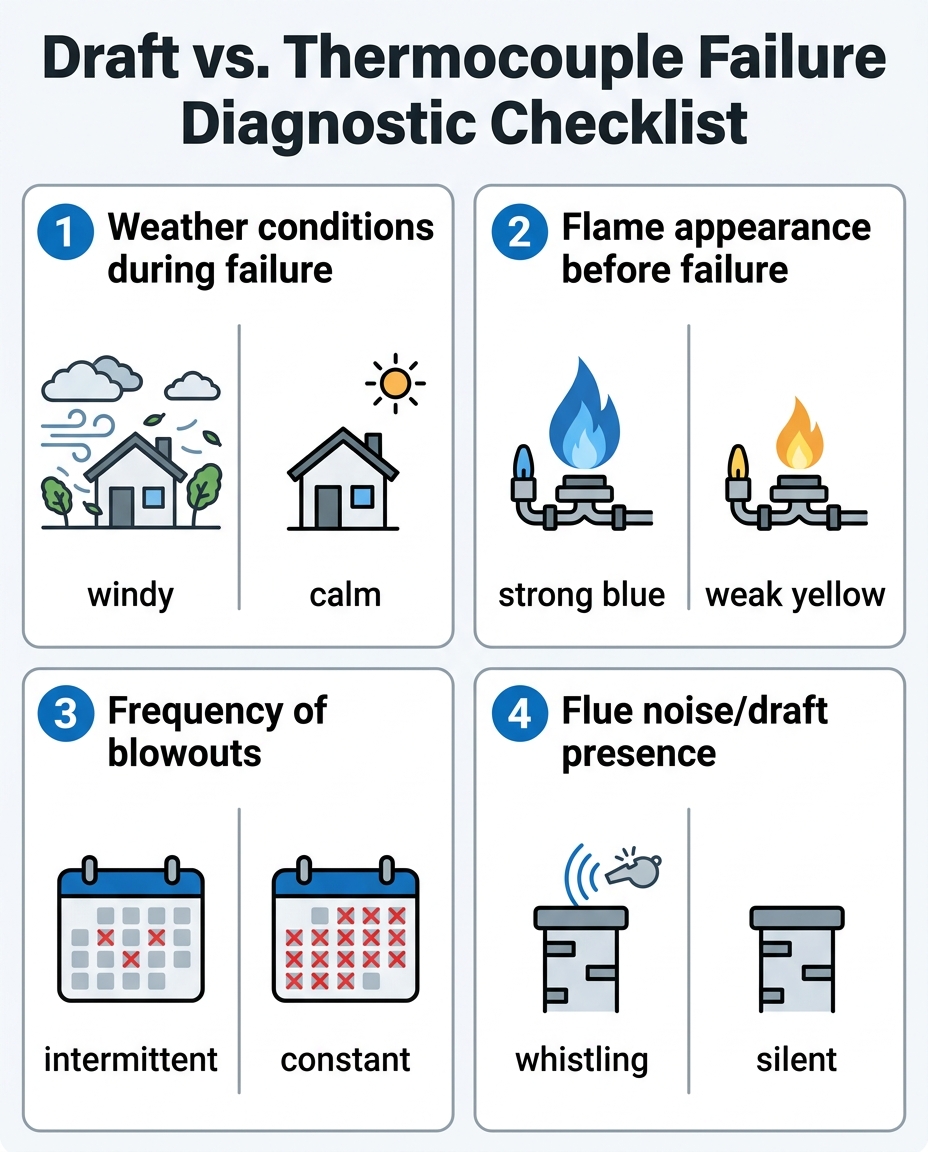
Draft issues and thermocouple failures present very different symptoms if you know what to look for. Here is a breakdown of what typically points to a weather issue versus a mechanical breakdown in the homes we service:
• Weather Conditions — Points to a Wind / Draft Issue: Blowouts only occur during active storms, high-wind events, or extreme cold fronts. — Points to a Thermocouple Failure: Blowouts happen consistently, even on perfectly calm, mild autumn days.
• Flame Appearance — Points to a Wind / Draft Issue: The pilot flame looks strong, sharp, and entirely blue before it goes out. — Points to a Thermocouple Failure: The pilot flame appears weak, lazy, and mostly yellow, struggling to engulf the probe.
• Audible Clues — Points to a Wind / Draft Issue: You hear whistling sounds in the flue pipe or feel distinct cold air drafts in the boiler room. — Points to a Thermocouple Failure: The boiler room is quiet and draft-free when the system shuts down.
• The Relight Test — Points to a Wind / Draft Issue: The pilot stays lit easily once relit, functioning normally until the next major wind gust. — Points to a Thermocouple Failure: The pilot goes out immediately the second you release the gas valve button, refusing to hold.
• Frequency — Points to a Wind / Draft Issue: Intermittent failures tied directly to the evening weather report. — Points to a Thermocouple Failure: Constant, daily failures that gradually become impossible to relight.
The quick takeaway: If your pilot light refuses to stay lit even for a few seconds after you have held the gas button down for the required minute, the thermocouple is almost certainly dead and cannot generate the voltage needed to hold the valve open.

In our line of work, we know it is tempting to treat a blown-out pilot light as a minor inconvenience. You walk downstairs, push the button, hold a match, and go back about your day. However, treating your boiler like a manual appliance comes with significant hidden risks. A pilot light that repeatedly goes out on windy October nights (pre-winter startup) is a symptom of a larger instability in your heating system.
First and foremost are the safety implications. Every time the pilot goes out, the gas valve has to snap shut to prevent a dangerous situation. These safety valves are highly reliable, but they contain physical springs and seals. Forcing the valve to emergency-close dozens of times a month causes premature wear and tear on the internal components. If that valve ever fails to close completely when the flame dies, you risk a severe gas buildup in your home.
Beyond the immediate safety valve, we constantly warn our customers that constant cycling takes a toll on the entire boiler. If the issue is a weak flame caused by a dirty pilot orifice, the boiler is likely experiencing incomplete combustion. This leads to soot buildup inside the heat exchanger. Soot acts as an insulator, forcing your boiler to burn more fuel to heat the same amount of water, drastically reducing your system's efficiency.
Furthermore, if the thermocouple is slowly failing, it will eventually lead to a total system lockout. A pattern we see often is that this never happens on a convenient, sunny Tuesday afternoon. It happens at 2 a.m. during the coldest blizzard of the year, leaving your home without heat when you need it most. This is why prioritizing routine heating maintenance is so critical; our technicians can spot a weak thermocouple or a dirty pilot assembly and resolve it long before it leaves you shivering in the dark.
When you have narrowed down the symptoms and suspect either a draft issue or a failing thermocouple, the next step is professional verification. Gas appliances are not candidates for weekend DIY projects. The stakes are simply too high, and the physics involved in high-altitude combustion are too complex.
Testing a thermocouple requires more than just looking at the flame. Our licensed technicians use specialized digital multimeters capable of safely reading direct current in millivolts. By attaching adapters to the gas valve, we can measure the exact voltage the thermocouple produces under load. If the probe is generating 28 millivolts, it is perfectly healthy, and our technician knows to look elsewhere. If it is only generating 10 millivolts, it requires replacement.
Similarly, resolving draft issues in a mountain home requires a deep understanding of high-altitude physics. Our team will use draft gauges to measure the negative pressure in your flue. We may need to adjust the combustion air intake, evaluate the draft hood, or inspect the roof cap to ensure it is properly designed to deflect extreme mountain winds. Our team at MCR Services brings specialized knowledge in mountain-specific heating challenges and high-altitude, extreme cold weather systems, ensuring your boiler is calibrated specifically for the environment it operates in.
Disassembling gas valves, replacing pilot assemblies, or modifying vent pipes are strictly tasks for licensed professionals. Bringing in our experts for Mammoth Lakes heating services provides the peace of mind that your system is not just running, but running safely.
Yes, strong gusts can create a downdraft in the flue pipe that travels backward into the boiler. This sudden rush of air can physically extinguish the pilot flame, especially if the wind cap is damaged or missing. Properly installed draft hoods help mitigate this, but we often see extreme mountain winds overwhelm standard venting setups.
A draft issue correlates directly with windy weather, while a bad thermocouple will fail to keep the pilot lit even on perfectly calm days. If the pilot goes out immediately after you release the gas button during the relighting process, the thermocouple is likely dead. A healthy thermocouple will hold the valve open effortlessly once heated for about a minute.
The thermocouple is designed to shut off the gas safely if the flame dies, preventing immediate danger. However, repeated failures indicate a malfunction that could eventually compromise the safety valve through excessive wear and tear. We advise that it is unsafe to bypass safety mechanisms or continually relight a failing system without having a professional diagnose the root cause.
Cold nights often coincide with barometric pressure changes and higher winds, which can disrupt the natural draft of your chimney. Additionally, the boiler runs much more frequently on cold nights, putting more thermal stress on a weakened thermocouple. Cold, dense air can also alter the combustion mixture, making a dirty pilot flame even weaker.
Yes, thinner air at high altitudes like Mammoth Lakes (high altitude mountain climate) affects the air-to-fuel ratio required for proper combustion. Boilers at elevation require specific adjustments to maintain a strong, stable pilot flame. Systems that are not properly calibrated for high altitude are inherently more vulnerable to environmental disruptions and downdrafts.
Waking up to a freezing house because the boiler shut down overnight is a harsh way to start the day. Knowing the difference between a weather-induced draft and a mechanical failure is the first step in regaining control of your home's comfort. Whether it is those windy October nights (pre-winter startup) blowing down your flue or a worn-out thermocouple refusing to hold the gas valve open, ignoring the symptom will only lead to a larger breakdown.
Ensuring your boiler is safe, efficient, and ready for the extreme mountain weather requires a professional technician's touch. Don't wait for a total system lockout in the middle of a blizzard. Schedule a thorough inspection and professional heating system repair with our MCR Services team now, so you can enjoy the winter season with absolute confidence in your home's heating reliability.