Understanding the Role of MERV Ratings When Filtering Fall Wildfire Smoke
Understanding the Role of MERV Ratings When Filtering Fall Wildfire Smoke
The Hidden Cost of Suffocating Your Furnace During Smoke Events
You notice the sky turning that familiar hazy orange, and the smell of burning timber slowly seeps into your living room. Your immediate reflex is to block it out completely. Understanding the role of MERV ratings when filtering fall wildfire smoke is critical in this exact moment, because the very filter you buy to protect your indoor air quality might be quietly destroying your heating system. When a heavy smoke event rolls in, our team at MCR Services Inc. often sees homeowners naturally rush to the hardware store to purchase the thickest, highest-rated filter available. It feels like the right move for your family's health.
Here is the hidden problem: you are forcing a system designed for temperature control to act as a hospital-grade air purifier. Your home's heating and cooling equipment relies on a very specific volume of air moving through the ductwork at all times. When you install a dense, highly restrictive filter to block fine ash, you inadvertently suffocate the blower motor. The fan has to work exponentially harder just to pull a fraction of the necessary air through that tight weave. For more details on optimizing your equipment's performance and protecting its lifespan, learn about HVAC system airflow and how it impacts your entire home.
During the typical September wildfire smoke season, this creates a frustrating dilemma. You want clean air, but you also need a functional furnace as the overnight temperatures begin to drop. Balancing these two needs requires looking past the marketing claims on the filter box and understanding the mechanical reality of your system.
What PM2.5 Is and Why We Reach for High MERV Ratings
To understand why we instinctively reach for the most restrictive filters, you first have to understand the specific threat posed by wildfire smoke. The primary danger in wood smoke is a microscopic particle known as PM2.5. This stands for particulate matter that is 2.5 micrometers in diameter or smaller. To put that in perspective, a single strand of human hair is about 70 micrometers across. PM2.5 is so incredibly small that it remains suspended in the air for long periods, easily bypassing your body's natural respiratory defenses and entering your bloodstream.
Because the threat is so severe, public health guidelines often recommend upgrading your home's air filtration. This is where the MERV scale comes into play. MERV stands for Minimum Efficiency Reporting Value. It is a standardized rating system that measures how effectively a filter traps particles of various sizes.
• MERV 1 to 4: Basic fiberglass filters designed only to catch large debris like lint and dust mites. They protect the equipment, not your lungs.
• MERV 5 to 8: Pleated filters that capture mold spores, pet dander, and standard household dust. This is the sweet spot for most standard residential systems.
• MERV 9 to 12: Higher-efficiency filters that trap finer particles, including auto emissions and some larger smoke particles.
• MERV 13 to 16: Hospital-grade filtration capable of trapping up to 90 percent of PM2.5 particles, bacteria, and microscopic allergens.
When the Mammoth Lakes region is blanketed in heavy smoke, consumers naturally gravitate toward MERV 13 or higher. If a MERV 8 is good, a MERV 13 must be better, right? The Environmental Protection Agency (EPA) even suggests using MERV 13 filters during severe smoke events if your system can handle it. The critical phrase in that recommendation is "if your system can handle it." Without realizing it, many homeowners install these dense filters into standard furnace heating equipment that lacks the blower capacity to pull air through such a tight barrier, setting off a chain reaction of mechanical failures.
The Physics of Filtration: How Dense Filters Act Like a Wall
To understand why a premium filter can ruin a good furnace, we have to look at the physics of airflow. Your HVAC system operates on a delicate balance of supply and return air. The blower motor creates negative pressure to pull stale air out of your home through the return ducts, pushes it through the heat exchanger to warm it up, and then forces it back into your living spaces through the supply vents.
Think of your blower motor like your lungs while you are out for a run. If you wear a lightweight surgical mask, you can still breathe relatively normally, even if there is a slight bit of resistance. Now, imagine trying to run that same distance while breathing through a heavy wool blanket. Your lungs have to strain violently to pull in enough oxygen, and eventually, you will have to stop. A high-MERV filter acts exactly like that wool blanket on your HVAC system.
Understanding Static Pressure Drop
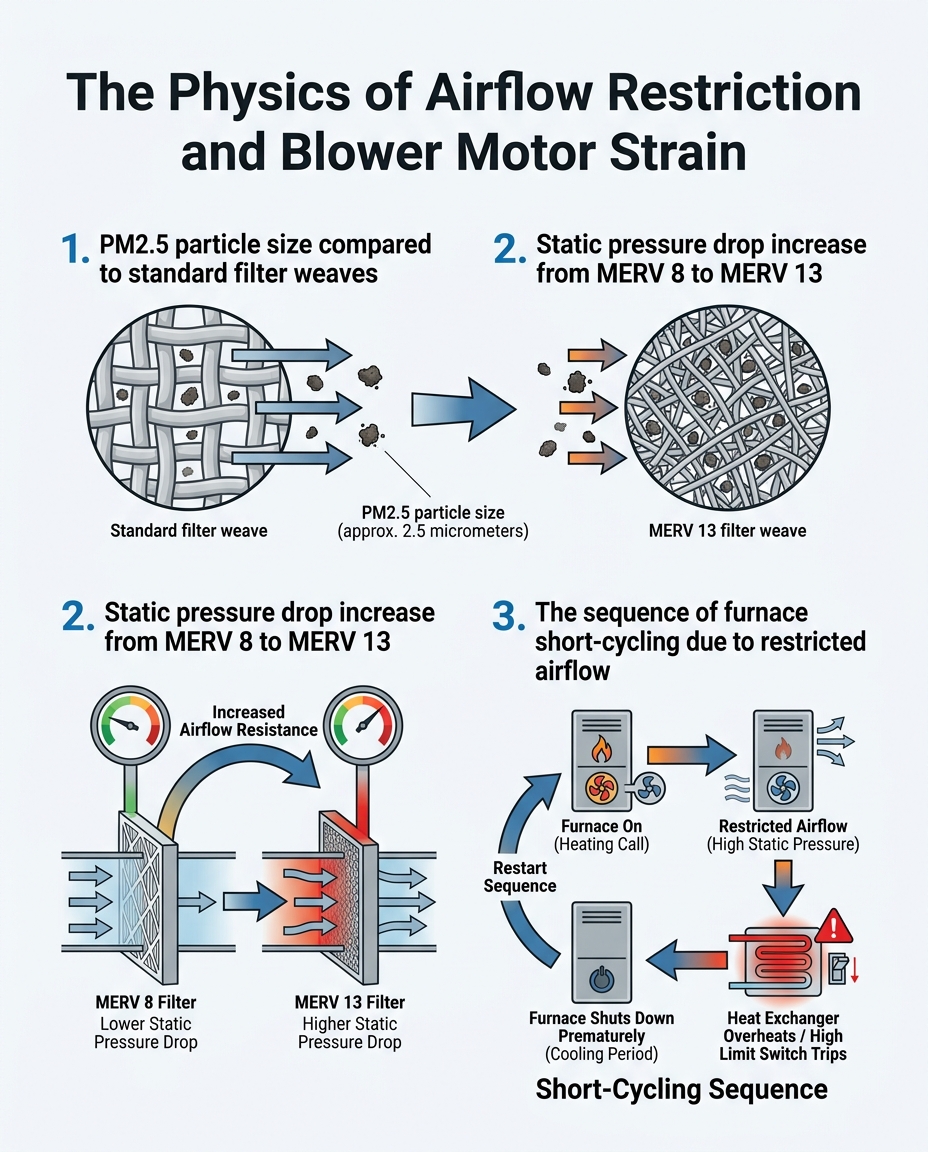
In the HVAC industry, this resistance is measured as static pressure. When air meets a physical barrier—like the tight, restrictive weave of a MERV 13 filter—the pressure drops on the other side of that barrier. This is known as the MERV 13+ static pressure drop. The higher the filter's rating, the denser the material, and the greater the pressure drop across the heat exchanger.
In our experience servicing HVAC systems across Mammoth Lakes, we find that standard residential systems are simply not engineered for high-static-pressure environments. Systems designed specifically for high filtration feature oversized filter cabinets (often 4 to 5 inches thick instead of the standard 1 inch) to increase the surface area. They also utilize variable-speed ECM (Electronically Commutated Motor) blowers that can automatically ramp up their speed to overcome the resistance. If you slide a 1-inch MERV 13 filter into a standard residential setup, you are effectively building a wall inside your ductwork. The blower motor will pull harder, consume more electricity, and still fail to move enough air to keep the system functioning properly.
The Physics of Airflow Restriction and Blower Motor Strain
The Danger to Your Blower Motor Just When the Cold Arrives
The consequences of suffocating your furnace go far beyond just poor airflow in your living room; it directly threatens the mechanical survival of your heating equipment. When a high-MERV filter restricts the airflow, the air moving over the furnace's heat exchanger slows to a crawl. Because the heat exchanger is still firing at full capacity, that trapped, slow-moving air absorbs too much heat. The internal temperature of the furnace cabinet skyrockets.
Modern furnaces are equipped with a vital safety device called a high-limit switch. This sensor monitors the temperature inside the cabinet. If the heat exchanger gets dangerously hot—which happens quickly when airflow is blocked—the limit switch trips and instantly shuts down the burners to prevent a catastrophic fire. The blower fan will usually keep running to cool the system down. Once the temperature drops back to a safe level, the furnace fires up again. However, because the restrictive filter is still in place, the system overheats again a few minutes later, and the limit switch trips once more.
This rapid, repetitive on-and-off sequence is called short-cycling. Short-cycling is incredibly destructive to HVAC equipment. It subjects the heat exchanger to extreme thermal stress, which can lead to cracking, and it forces the blower motor to constantly stop and start under heavy resistance. Eventually, the blower motor will burn out completely.
The timing of this failure is often the worst part. In our years working in the Mammoth Lakes region, our technicians have noticed that the most severe smoke events frequently overlap with early fall frosts. You cannot afford to lose your heating system exactly when the smoke is heaviest and the overnight temperatures plunge. Sacrificing your furnace in an attempt to filter the air leaves your home both cold and vulnerable.
Safe Filtration Limits for Standard Residential Systems
Protecting your indoor air quality does not have to come at the expense of your furnace. By following physics-based guidance, you can find the right balance between filtration and mechanical safety. Here is how our team recommends managing your home's air without pushing your equipment past its breaking point.
1. Identify your system's maximum rating: Most standard 1-inch residential filter cabinets are designed to handle a maximum of MERV 8 to MERV 11. Anything higher usually requires a specialized media cabinet or a heavy-duty blower motor.
2. Check the manufacturer specifications: Pull out your furnace owner's manual or look up the model number online. Look for the maximum allowable external static pressure. If your system is not rated to handle a severe MERV 13+ static pressure drop, do not force one into the slot.
3. Adopt a high-frequency replacement strategy: Instead of relying on a thick, restrictive filter to do all the work for months on end, use a safe-rated filter (like a MERV 8) and change it much more frequently during a smoke event. A fresh MERV 8 filter moving a high volume of air is often better for your home than a clogged MERV 13 filter moving almost no air. During heavy smoke, you may need to replace standard filters every two to three weeks.
4. Inspect the filter for bowing: If you pull your filter out and notice that the cardboard frame is bent, bowed, or sucked inward toward the blower, that is a glaring visual sign that the filter is too restrictive or too dirty. The motor is literally trying to suck the filter into the fan assembly.
Managing air quality requires a holistic approach. If you are struggling with dry, irritated airways during smoke season, you might also be choosing between an air purifier and a humidifier to find relief. Knowing the limits of your central ductwork helps you make better decisions about supplementary equipment.
Alternative Strategies for Managing Wildfire Smoke Indoors
If your furnace cannot safely accommodate a MERV 13 filter, you still have highly effective options for keeping your indoor air clean. The best approach is often to decouple your heavy filtration needs from your home's primary heating and cooling equipment.
Deploy Standalone HEPA Purifiers: Instead of relying on your furnace to filter the entire house, place standalone True HEPA air purifiers in high-traffic rooms, such as the living room and bedrooms. HEPA (High-Efficiency Particulate Air) filters capture 99.97% of fine particles, including PM2.5. Because these units have their own dedicated fans built specifically for high resistance, they clean the air aggressively without involving your furnace's blower motor at all.
Run the HVAC Fan Continuously: If you have a safe, system-approved filter installed (such as a MERV 8 or 11), you can switch your thermostat fan setting from "AUTO" to "ON" during the September wildfire smoke season. This keeps the air continuously circulating through the filter, steadily scrubbing the air over time rather than only filtering when the heating cycle kicks on. Just ensure you are checking the filter weekly, as continuous operation will load the filter with ash much faster.
Prioritize Pre-Season System Upkeep: A blower motor that is already struggling with dust buildup or failing bearings will die even faster when exposed to smoke-heavy air. For example, our team at MCR Services Inc. recently helped a local homeowner who reached out this past fall needing general HVAC system installation and repair after struggling to keep their home comfortable during a heavy smoke event. By providing prompt service and tailored solutions for their equipment, we ensured their home's needs were consistently met without putting undue strain on their system. Ensuring your equipment is clean and calibrated before the season starts is vital. Scheduling routine HVAC maintenance ensures your blower motor is strong enough to handle seasonal demands safely.
Why Local Climate Expertise Matters for Your HVAC System
When environmental emergencies strike, it is easy to rely on generic national advice. A quick internet search will almost always tell you to "buy the highest MERV rating possible" to combat wildfire smoke. But generic advice does not account for local mechanical realities. In high-altitude environments, the delicate balance between high-altitude heating requirements and aggressive smoke filtration requires a nuanced approach.
Working with our professionals, who possess deep local expertise in Eastern Sierra climate challenges, means you get solutions tailored to your actual environment. At MCR Services Inc., we understand firsthand that a suffocated furnace in October is just as dangerous as poor air quality in September. Balancing these two factors requires a thorough understanding of static pressure, blower motor capabilities, and local weather patterns. If you are unsure whether your current setup is safe for the upcoming season, consulting with our professionals for Mammoth Lakes HVAC services ensures your equipment is evaluated properly.
You do not have to choose between breathing clean air and keeping your home warm. With the right strategy, proper standalone equipment, and a healthy respect for your furnace's airflow requirements, you can successfully navigate smoke season without sacrificing your heating system.
Frequently Asked Questions
Can a MERV 13 filter damage my furnace? Yes, if your standard residential furnace is not rated for it, a MERV 13 filter can cause severe damage. The dense weave drastically restricts airflow, which can cause the heat exchanger to overheat, trip the safety limit switch, and eventually burn out the blower motor due to continuous strain.
What is the highest MERV rating a standard furnace can handle? Most standard residential HVAC systems are designed to safely handle a maximum of MERV 8 to MERV 11. Upgrading beyond this usually requires a specialized, thicker filter cabinet and a variable-speed blower motor capable of overcoming the increased air resistance.
How does static pressure drop affect my HVAC system? Static pressure drop refers to the loss of airflow caused by a physical barrier like a thick filter. When this pressure drop is too high, the blower motor has to work much harder to pull air through the system, leading to poor air circulation, increased energy consumption, and mechanical overheating.
Does MERV 11 filter wildfire smoke effectively? A MERV 11 filter does a very good job of capturing a large percentage of fine particles, including some wildfire smoke, without causing the severe airflow restriction of higher-rated filters. It is often the safest compromise for standard residential systems during a smoke event.
How often should I change my filter during a fire? During a heavy wildfire smoke event, you should check your filter weekly and be prepared to change it every two to three weeks. Ash and fine particulate matter will clog the filter material much faster than standard household dust, rapidly decreasing your system's airflow.
Why does my furnace shut off repeatedly when I install a new filter? If your furnace short-cycles right after installing a new, high-efficiency filter, the filter is likely too restrictive. The lack of airflow causes the furnace to overheat, triggering the high-limit safety switch to shut the system down to prevent a fire.
Keeping Your Air Clean and Your Furnace Safe
Navigating fall wildfire smoke doesn't mean you have to put your home's heating equipment at risk. A clear, physics-based approach to filtration ensures your indoor air stays clean while your blower motor stays intact. By respecting your system's airflow limits and utilizing smart alternatives, you can protect your family's comfort all season long.
Sed iaculis aenean sit sed risus arcu vitae integer elit.
5 min read
Navigating Heating Upgrades for Historic and Older Homes in Big Pine
Vintage properties shouldn't force you to choose between modern comfort and original architecture. Explore ductless heating alternatives that protect your home's charm before winter arrives.
Understanding the Role of MERV Ratings When Filtering Fall Wildfire Smoke
Buying a hospital-grade filter during heavy smoke events feels smart, but high-MERV filters can actually suffocate your furnace blower. Learn how to balance indoor air quality and equipment safety.
Gas Furnaces vs. Electric Boilers: Weighing Heating Costs in the Eastern Sierra
Assess your heating options before the snow falls. See how the rapid response of a gas furnace compares to the steady warmth of an electric boiler to maximize your home's winter efficiency.